
World
'Crazy' phone call between Trump and Netanyahu complicates Iran talks
June 4, 2026 International Source: BBC World
Israel's PM laughed off reports of friction, but he has tested the patience of other US presidents.
'Crazy' phone call between Trump and Netanyahu complicates Iran talks
Traffic at a standstill as people flee southern Beirut
Copyright current_year BBC. All rights reserved. The BBC is not responsible for the content of external sites. Read about our approach to external linking.
Copyright current_year BBC. All rights reserved. The BBC is not responsible for the content of external sites.
Read about our approach to external linking.
Despite several public disagreements, Netanyahu has repeatedly called Trump Israel's "greatest" friend in Washington
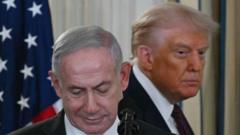
Netanyahu and Trump at a podium in 2025.
Donald Trump has become the latest US president to find himself at odds with Benjamin Netanyahu, after reportedly clashing with the Israeli prime minister over military action in Lebanon that has thrown Washington's Iran diplomacy into crisis.
Tehran responded to Israel's strikes on Lebanon by threatening to suspend talks with the US - a potential setback to Trump's efforts to extricate himself from an unpopular war with Iran.
Trump was asked by a journalist about an Axios report that he had called Netanyahu "effing crazy" and accused him of ingratitude during a phone call on Monday.
"I did," Trump told the Pod Force One podcast in an interview broadcast on Wednesday. "I wouldn't say angry. I was a little bit perturbed at his constantly fighting with Lebanon, you know."
Trump added: "I like Bibi a lot. And I work very well with him."
He would be far from the only US president to tangle with the Israeli PM. The prime minister has a long history of testing the White House's patience - and of politically surviving any fallout.
The latest reported clash came as Trump mulls a deal that would extend the US-Iran ceasefire and open the door to talks on the future of Tehran's nuclear programme.
The reopening of the Strait of Hormuz - a vital global shipping lane - is also at stake.
Netanyahu laughed off any suggestion of tensions with his American ally.
"Sometimes we have, as in the best of families, you have these tactical disagreements," he told CNBC in an interview on Wednesday. "We always find a way to work them out, and we do so as great friends."
He added that the two can "disagree in the morning" and be in agreement by afternoon.
Experts, however, cautioned that the call could point to frustration in the White House over the alignment of US and Israeli military and political goals nearly 100 days after they launched strikes on targets in Iran on 28 February.
"Netanyahu has a long history of doing his own dance, irrespective of what he has heard from Washington," Brett Bruen, a former diplomat and president of crisis communications agency the Global Situation Room, told the BBC.
"Trump… decided to take the plunge with him, and is now learning a really hard lesson about what happens when you get into war with a pretty mercurial leader that has an agenda which doesn't always align with your own priorities," he added.
John Sudworth wearing a shirt with the top button undone. Behind him is a gridlocked road.
Broadly, Netanyahu and Trump agree on the key US objective of preventing Iran from manufacturing or having a nuclear weapon.
In Lebanon, however, those interests slightly diverge, with Israel vowing to target the Iran-backed Hezbollah militia even as US-Iran talks continue. Iran has insisted that any ceasefire must also include Lebanon.
It comes as a growing percentage of the American public has grown critical of longstanding US support for Israel.
One Pew Research Poll released in April found that 60% of Americans now hold a negative view of Israel. Before the start of the war with Hamas in 2023, 42% held a negative view.
Several prominent conservative figures have also publicly spoken out against what they perceive as an Israeli role in convincing Trump to go to war in Iran, which the White House and Netanyahu deny.
Among the prominent critics of the war is Joe Kent, who led the National Counterterrorism Center before resigning in March, citing a belief that "we started this war due to pressure from Israel and its powerful American lobby".
The pro-Israel lobbying group, the American Israel Public Affairs Committee, responded to Kent's exit by reposting a statement accusing him of trafficking in "old-age antisemitic tropes".
In this political climate, some observers believe that Trump has an incentive to disagree with Netanyahu to placate critics at home in the US.
"I think there is a political necessity now to create daylight between Israel and the US," Bruen added.
"Whether it's in Lebanon or in Gaza, there are things that Netanyahu has chosen to do which are politically problematic even for Trump or the Republicans."
Other US presidents have found themselves frustrated by Netanyahu.
The Israeli prime minister famously clashed with Bill Clinton over the implementation of the Oslo peace accords.
He had an even more difficult relationship with President Barack Obama, particularly after a March 2015 speech to Congress - focused on Iran policy - that was scheduled without the White House's knowledge.
Netanyahu's relationship with Biden also seemed to sour after he accused the US of withholding weapons and ammunition - comments that White House officials described as "vexing" and "deeply disappointing".
"He's had extremely fraught relationships with US presidents," said Natan Sacks, an expert on US-Israeli relations at the Washington-based Middle East Institute.
"He is a very difficult negotiator, not just in terms of being tough, but in terms of being very suspicious," Sacks added.
Trump has previously expressed frustration with Netanyahu, and used an expletive on camera in front of reporters last year after Israeli strikes on Iran threatened a shaky ceasefire at the end of the so-called 12-day war with Tehran.
But overall, their relationship has been largely positive, and Netanyahu has repeatedly described Trump as the "greatest friend to Israel" in US history.
"With Trump, he [Netanyahu] found someone who is willing to break the mould for how Middle East affairs are conducted," Sacks said.
"That's something Netanyahu related very easily. He wanted to change the rules of the game and the willingness of the US and Israel to militarily confront the Iran axis."
Whether their recent apparent disagreement will change that warm relationship in the long term, however, is unclear.
"It's potentially significant. We don't know if it was a one-time event or a harbinger of broader things," Sacks said.
"I would not rule that out. The president has changed his mind about many people in the past."
Smoke billows from an Israeli air strike in the Nabatieh area, southern Lebanon (2 June)
Israel strikes southern Lebanon but partial truce with Hezbollah appears to hold
A family including a person in a wheelchair stand next to the window of the Jabal Amel hospital and look out to survey extensive damage to the neighbourhood, with broken glass and rubble on the floor of the hospital room they stand in, in Tyre on Monday.
Clashes continue in Lebanon despite Israel and Hezbollah accepting US partial ceasefire plan
A man wearing a light-coloured polo shirt, a beard and black baseball cap rides a motorbike carrying one child in front, another behind him followed by a woman wearing a headscarf and holding the child on her lap. Two men on bikes - one with sunglasses on his head, the other wearing a white T-shirt - are on the road where heavy traffic can be seen. To the left of the riders, a black iron fence can be seen behind which there is an apparent green-grass garden with beds of flowers as well as the trunks of two palm trees.
Israel PM orders strikes on Beirut suburbs as Hezbollah conflict escalates
Iran says the attack on Kuwait was in retaliation for earlier US strikes on an Iranian oil tanker and island.
The rideshare company's annual Lost & Found Index also reveals America's most forgetful city, and the most forgetful day.
The $1.8bn fund would have paid people the Trump administration decided were unjustly and politically targeted.
The incidents strain a partial ceasefire agreed by Israel and the Lebanese armed group on Monday.
Delcy Rodríguez's India visit highlights Venezuela's growing role in Delhi's oil diversification.
Republican lawmaker Tom Kean Jr has not been seen in Washington or his New Jersey district for several months.
Acting Attorney General Todd Blanche's announcement to abandon the fund comes amid pushback from top Republican lawmakers.
Israel continues its campaign in the south, though has not struck Beirut after a deal announced by the US.