
World
Trump hits back at 'unpatriotic' vote after House rebukes him over Iran
June 4, 2026 International Source: BBC World
The lower chamber of Congress passed a measure that seeks to halt further military action, in a vote seen as largely symbolic.
Trump hits back at 'unpatriotic' vote after House rebukes him over Iran
Watch: Moment House votes to limit Trump's Iran war powers
Copyright current_year BBC. All rights reserved. The BBC is not responsible for the content of external sites. Read about our approach to external linking.
Copyright current_year BBC. All rights reserved. The BBC is not responsible for the content of external sites.
Read about our approach to external linking.
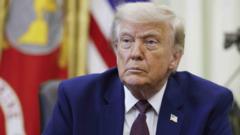
File image of US President Donald Trump at the White House
Image shows the number of Republicans, Democrats and Independents who voted on the War Powers Act.
US President Donald Trump has hit back at lawmakers who voted to send him a rebuke over the war in Iran, calling them "unpatriotic".
On Wednesday, the US House of Representatives passed a measure seeking to halt Trump from taking further military action amid growing opposition to the war.
In a post on Truth Social, the president wrote: "Yesterday, in a meaningless vote, the House voted, 4 bad Republicans and all of the Dumocrats, to limit my War Powers, right in the middle of my final negotiations to end the War with the Islamic Republic of Iran. Who would do such an unpatriotic thing."
It is unclear how much legal force the House's measure will have. The White House has dismissed its merits.
It has also described the move as an unconstitutional attempt to restrict presidential power.
The vote, which passed 215-208, was to adopt the war powers resolution, which would require Trump to withdraw US forces or seek congressional approval for the conflict.
The road to actual enforcement would involve the legislation clearing several thorny political, procedural, and legal hurdles.
Nonetheless, the vote sent an unusually blunt message from Congress to the White House.
"There's a political impact, because a majority of one House of the Congress have gone on record, in an actual vote, that the US armed forces need to be withdrawn from hostilities in the Persian Gulf," said Michael Glennon, a professor of constitutional and international law at Tufts University.
"Congress is in effect saying: now, we really, really, really, really think this is unlawful, and you need to get out," Glennon said.
The measure considered was a concurrent resolution -- meaning that if an identical version is also passed by the Republican-controlled US Senate, it would not require the president's signature.
And even if that did occur, it could face a legal challenge from Trump.
Meanwhile, if the Senate opts to tweak the language, it becomes what is known as a joint resolution - which would require Trump's signature. The president would likely veto it, and Congress does not have enough votes to override him.
The U.S. Capitol Building is seen on a clear, spring day on May 30, 2026 in Washington, DC
US House delivers rebuke to Trump as it votes to halt Iran war
Trump's post on Thursday morning went on to say: "The Democrats are fueled by Trump Derangement Syndrome. They would rather have our Country fail than give me another, of many, victories.
"The four Republicans, that's a whole other story - They're GRANDSTANDERS! They should be ashamed of themselves."
This was the fourth attempt by the House to rein in Trump's war powers. The Senate advanced a similar resolution in May but has yet to hold a full floor vote.
Some of Trump's critics in Congress argue that Trump is already in violation of the War Powers Resolution. That federal law prohibits the president from deploying troops for military action for more than 60 days, without Congressional approval. Trump has passed the 60-day deadline, but his administration has argued that the restriction is unconstitutional.
Despite being seen as largely symbolic, the passage of Wednesday's resolution adds to the pressure on the White House to find an end to the war, as petrol prices have spiked and public opposition to the war has increased.
Sixty-four percent of registered voters believed Trump was wrong to go to war with Iran, compared to 34% who believed he made the right call, a New York Times/Siena poll taken in May suggested.
The poll suggested that support for Trump's decision was divided along partisan lines; 93% of Democrats believed Trump was wrong, while 70% of Republicans believed Trump was correct. However, 73% of independent voters - often a bellwether group in national elections - opposed the war, polling indicated.
The vote also marked the latest sign of division within Trump's Republican Party, coming just days after a revolt by conservatives in Congress led his administration to pull back plans for a $1.8b "anti-weaponization" fund for political allies.
The four Republicans who attracted Trump's ire were Thomas Massie, Brian Fitzpatrick, Tom Barrett, and Warren Davidson, who joined a united front of Democrats. Democrat Jared Golden of Maine, who had previously voted against similar measures, gave his support this time.
"Congress alone declares war, that's something certainly we need to be protective of," Barrett, a Republican from Michigan, said. Asked if he was worried about retribution from Trump for his vote, he said: "I vote my conscience for what I think is right and willing to accept that."
Trump's former advisor turned critic had reached a deal with prosecutors, two people said.
Hundreds of the Hollywood icon's personal possessions have been put up for auction in California.
Jamshid Ghomi, 63, is alleged to have shipped sensitive computer systems to Iran, using his profits to build a luxury mansion.
If confirmed by the Senate, Trump's former personal lawyer would become the administration's number one prosecutor.
In the 215-208 vote, four Republicans joined Democrats to pass the measure, which is largely symbolic.
The bill to fund immigration agencies has been delayed by opposition to Trump's 'anti-weaponisation fund'.
Israel's PM laughed off reports of friction, but he has tested the patience of other US presidents.
The $1.8bn fund would have paid people the Trump administration decided were unjustly and politically targeted.