
World
Mangrove forests are healing after decades of human destruction
June 5, 2026 International Source: BBC World
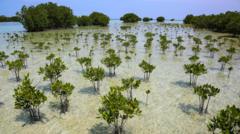
Swampy mangrove forests are staging a surprise comeback - which is good news for coastal communities and the climate.
Mangrove forests are healing after decades of human destruction
Copyright current_year BBC. All rights reserved. The BBC is not responsible for the content of external sites. Read about our approach to external linking.
Copyright current_year BBC. All rights reserved. The BBC is not responsible for the content of external sites.
Read about our approach to external linking.
Small mangrove trees sit spread out in clear shallow seawater, in the background is denser patches of mangrove forest. The sky is blue.
Matt McGrath & Esme Stallard, BBC Climate & Science
The world's coastal mangrove forests, which protect millions of people from storms - and soak up vast amounts of planet-warming gases - are staging an unexpected comeback, scientists find.
For decades these swampy trees had been declining rapidly as they were cleared for fish farms and housing.
But a new study shows that since 2010 the world has been gaining more mangroves than it has been losing - driven by stronger legal protections and increased public awareness of their importance, sparked by disasters such as the 2004 Indian Ocean tsunami.
The researchers say the key factor though is the remarkable capacity of these forests to regenerate naturally once humans stop chopping them down.
Some communities have become more aware of the importance of mangroves for coastline protection following extreme weather
A man in a blue t shirt and dark trousers walks along a boardwalk towards the sea. He is carrying two mangrove saplings in his hands and either side of the boardwalk are saplings already planted in the water. Men in the background are blurred also planting in the water.
Mangroves are one of the world's unsung environmental heroes.
Not only do they store up to five times more carbon dioxide than land-based forests, but their tangled roots can also slow down waves and protect coastal communities from storm surges and tsunamis.
carbon dioxide than land-based forests, but their tangled roots can also slow down waves and protect coastal communities from storm surges and tsunamis.
These same roots provide a perfect nursery for many species of fish and other marine life - protecting them from predators and providing ample food.
These benefits, though, have come under serious threat over the past century as the rise of fish farming, agriculture and the expansion of coastal cities and towns have seen mangroves chopped down and rapidly removed.
From the 1980s to 2010, over 12,000 sq km (4,600 sq miles) of mangroves were cleared or destroyed across Asia, Africa and the Americas - an area the size of Jamaica.
However, the new study shows a real reversal of that trend, particularly over the last decade. The total net losses - the forest lost and not replaced - since the 1980s have now been reduced to around 849 sq km (328 sq miles).
Restoration efforts over decades have helped degraded forests to recover, but the big change has come from the natural expansion of mangroves in many parts of the world following drops in deforestation.
This has enabled forest levels to stabilise in Indonesia and grow in Myanmar (formerly known as Burma) - two of the most mangrove-dense countries.
In Indonesia, the aftermath of the Indian Ocean tsunami in 2004 seems to have played a role in changing people's minds about the importance of mangroves, and the removal of trees for fish farming has slowed.
"Some islands were covered by mangroves and after the tsunami those islands were [still] protected very well, so that increased public awareness about the importance of protecting mangroves," said lead author Dr Zhen Zhang from Tulane University in the US.
A similar change in public attitude occurred in Myanmar after Cyclone Nargis in 2008 and a national logging ban in 2016.
Technology is also part of the answer, say the authors. For this study, a different satellite imaging system was used to map the forests in more detail, showing far greater numbers of new trees compared to previous studies.
This imagery came from the Landsat satellite "which is highly sensitive to canopy changes, and provides globally consistent observations that previous assessments may have missed," said Prof Elizabeth Robinson, director of the Grantham Research Institute, who was not involved with the study.
"This is a considerable advance on earlier global assessments," she told BBC News.
Some of the expanding growth, though, is likely to be double edged - it may be at the expense of environmental damage in other locations.
In many countries, including Brazil, new mangrove forests have taken hold along rivers and coastlines with an abundant supply of nutrients in the sediments.
But it has been the destruction of forests and mining further upstream which may have flushed the nutrients, like nitrogen, from soils into waterways, benefitting the mangroves down the river.
"This is good news for mangroves - there are more of them than we thought, and they are showing their resilience," said Dr Pete Bunting from Aberystwyth University, another of the authors.
"But it is only really good news if it is not a complete mess upstream."
The research also shows that whilst a combination of restoration and a reduction in chopping down mangroves has been successful, it has not been a uniform success across the globe.
West and Central Africa have emerged as hotspots of destruction.
"The Niger Delta is the poster child for mangrove pollution impact," said Bunting.
"Oil pollution is having massive impacts - and if you look at Google Earth you can see straight lines through the mangroves where the pipelines are."
Since 2010 there has been a significant natural expansion of mangroves in many coastal areas
A mangrove tree stands in shallow water with the blue sea beyond, the mangrove has multiple roots reaching down into the water. Surrounding it are other mangrove trees and in the background shallow blue sea and blue sky with white clouds.
Tropical cyclones also remain a serious threat - with storms responsible for some of the most dramatic single year losses recorded in the study, from Australia to the Caribbean.
Despite this, the authors agree this is a good news story.
"We are moving in the right direction because you can see a very clear trend of decreased loss rate," Dr Zhen Zhang told BBC News.
The study also found that many existing forests were actually becoming healthier. Since the 1980s, the proportion of closed canopy mangroves, the richest and most carbon-dense, has grown by nearly 20%.
"So, I think we are going the right way," said Zhen.
Promotional image showing parched ground, planet Earth, and green semicircle
A sombre-looking middle-aged woman covered in mud walks down a flooded street in Valencia which is filled with damaged furniture, kitchen appliances and other household goods after heavy rain and flooding hit large parts of Spain on 2 November, 2024. To the right of the image is A badly-damaged car with no windows.
Four ways climate change worsens extreme weather
Promotional image with person cycling, a power station in background, and green semicircle
What you can do to reduce carbon emissions
Thin, green banner promoting the Future Earth newsletter with text saying, “Get the latest climate news from the UK and around the world every week, straight to your inbox”. There is also a graphic of an iceberg overlaid with a green circular pattern.
Sign up for our Future Earth newsletter to get exclusive insight on the latest climate and environment news from the BBC's Climate Editor Justin Rowlatt, delivered to your inbox every week. Outside the UK? Sign up to our international newsletter here.
to get exclusive insight on the latest climate and environment news from the BBC's Climate Editor Justin Rowlatt, delivered to your inbox every week. Outside the UK?
Sign up to our international newsletter here.
An internationally important nature reserve in Hampshire is under threat from failing flood defences.
High fuel prices are strengthening the case for EV adoption in the world's third largest auto market.
Suffolk County Council plans to audit all its environmental projects.
Figures show there were almost 150 animal dumping incidents in Northern Ireland since 2020.
Demonstrators say the project backed by Donald Trump's son-in-law would harm a protected environment.
Viridor can now increase waste at its Beddington energy recovery facility to 382,286 tonnes a year.
The National Trust, which manages Portstewart Strand, has urged visitors to the beach to be vigilant.
A farmer says he is having to remove litter from his fields on a daily basis.