
World
Astronauts return to ISS after sheltering during air leak repair attempt
June 6, 2026 International Source: BBC World
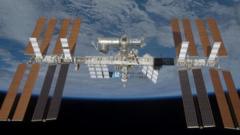
Russian attempt to repair tunnel area sparks safe-haven procedure for five other astronauts onboard.
Nasa tells ISS astronauts to shelter during air leak repair attempt
Copyright current_year BBC. All rights reserved. The BBC is not responsible for the content of external sites. Read about our approach to external linking.
Copyright current_year BBC. All rights reserved. The BBC is not responsible for the content of external sites.
Read about our approach to external linking.
The International Space Station is seen in the centre of the image in space orbiting the Earth
Astronauts return to ISS after sheltering during air leak repair attempt
Astronauts on the International Space Station (ISS) were ordered to shelter in an attached spacecraft after the structure suddenly started leaking more air.
Five of the seven crew were directed to go into the docked SpaceX shuttle Dragon "Freedom" on Friday afternoon and were braced for a potential evacuation.
Meanwhile, two remaining personnel - a pair of Russian cosmonauts - attempted to repair a part of the Russian segment of the ISS, where the leaks had started increasing on Monday.
The repairs were paused and the crew ordered back onto the ISS by Nasa on Friday afternoon.
Astronauts floating about and waving onboard in the International Space Station
Watch: Moment crew docks at International Space Station
Astronauts floating about and waving onboard the ISS
Jessica Meir, Jack Hathaway, Sophie Adenot and Andrey Fedyaev, who arrived on the ISS in February, had been sheltering on the docked ship, along with another astronaut Chris Williams.
They had been told to put on their spacesuits so they were ready to undock and return to Earth at short notice.
The Dragon effectively functions as a lifeboat - attached to the station but ready to detach the moment the order is given.
The trigger for the order was a worsening air leak in the transfer tunnel, known as PrK, leading to a section of the Russian segment of the station called the Zvezda service module.
Annotated image of the International Space Station (ISS) against a black space background, shown horizontally with extended solar panels on both sides. Sleeping quarters are labelled on an upper central module; The Zvezda module is on bottom half with a Progress supply spacecraft” attached below. The PrK transfer tunnel is highlighted in red between the two. The station’s structure, modules, and arrays are clearly visible, with metallic textures and solar panels.
Russian cosmonauts, station commander Sergey Kud-Sverchkov and flight engineer Sergei Mikaev, attempted to fix the problem. Their escape route was the separately docked Soyuz MS-28 spacecraft.
Retired Canadian astronaut Chris Hadfield, who was a commander of the ISS in 2012, said it had always leaked around half a pound of pressure a day.
"When you have an area that's leaking a little more, you get up to a pound a day, maybe a pound a half or even two, then we hit a threshold where, okay, we've got to do something about this," he told BBC Newshour.
"You're always one breath away from having to take shelter somewhere if the station has a problem. It's just a matter of fact of living on board a spaceship."
It is not the first time the station has had to deal with this latest leak - the cracks responsible have persisted on and off for around six years.
However, following the arrival of a Russian cargo ship last month, the Russian space agency Roscosmos noticed a fresh slow pressure drop in the tunnel, prompting the decision to move beyond patchwork fixes and attempt a more extensive repair operation on Friday.
But it was the method they were planning to use that prompted the order to take shelter, according to news agency Reuters.
Kud-Sverchkov and Mikayev were said to be using a saw to try and get into an area to access the crack that was leaking air.
Nasa disagreed with the method they were using and mission control in Houston ordered five crew to take "safe-haven" procedures on the Dragon ship.
(Left to right) Russian cosmonaut Andrey Fedyaev, Nasa astronauts Jack Hathaway, Jessica Meir and ESA astronaut Sophie Adenot
Four astronauts in white space suits hold hands and lift them in celebration at the Kenedy Space Centre entrance
When Roscosmos told their crew to pause repairs, Nasa instructed the astronauts to return to the station.
Nasa spokeswoman Bethany Stevens said on X: "Given this development, Nasa has instructed the crew members inside the Dragon spacecraft to end the safe haven procedures and return to planned operations aboard the International Space Station."
Russian news agency Tass, citing Roscosmos, reported that nothing had been threatening the safety of the crew or the ISS's onboard systems.
The ISS, which spans the length of a football field, is the largest human-made object in space.
It has been continuously operated by a US-Russian-led consortium that includes Canada, Japan and 11 European countries since 1998.
John McFall takes one step closer to becoming first disabled astronaut.
Scientists are attempting to build exercise equipment to be used on future space flights.
The prime minister met Canadian astronaut Jeremy Hansen and other crew members in Ottawa.
Nasa plans to send hopping drones and roving vehicles to the Moon as part of plans for a permanent Moon base.
The plans include permanent human habitation on the Earth's only natural satellite by 2032.
Jack Hathaway tells Cranfield University he had to wait for a break in the British weather.
Seeing Artemis has made space careers a reality for children, says a woman who promotes STEM jobs.
Reid Wiseman’s two daughters were in Nasa’s mission control room for the naming of the “Carroll” crater in honour of the commander’s late wife.