
World
Hundreds of captives freed from Boko Haram mountain hideout
June 7, 2026 International Source: BBC World
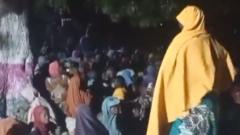
The group includes many women and children who were abducted in March from an area close to Cameroon.
Boko Haram captives: Hundreds freed from Nigerian militants' mountain hideout
Copyright current_year BBC. All rights reserved. The BBC is not responsible for the content of external sites. Read about our approach to external linking.
Copyright current_year BBC. All rights reserved. The BBC is not responsible for the content of external sites.
Read about our approach to external linking.
The former hostages received medical screenings and were gathered under trees overnight
A screengrab from a video showing a crowd of mainly and children, mostly from behind, as they sit under a treat after being freed from Boko Haram captivity. One of the women is standing to the right of the image and wears a yellow headscarf.
Hundreds of captives freed from Boko Haram mountain hideout
At least 360 people kidnapped by Boko Haram jihadists from a mainly Muslim community in Nigeria's north-eastern Borno state in March have been freed from a remote mountain hideout.
The circumstances of how they were freed are disputed. The army says it had launched an unprecedented intelligence-led operation that had been weeks in the planning and taken the Islamist militants by surprise.
But a local group, the Borno South Youth Initiative, says it mediated the unconditional release, putting the number of those freed at 416.
Mass abductions by armed groups for ransom have become a common tactic in Nigeria in recent years - and though it is illegal to pay ransoms, it does happen.
Boko Haram infamously kidnapped more than 200 schoolgirls from the village of Chibok in 2014 - around 90 of whom remain missing.
At the time the group forced its captives into sexual slavery, domestic servitude or used them as suicide bombers.
But a range of groups across Nigeria now use kidnapping to raise funds, focusing on soft targets such as schools, churches, mosques and remote villages.
Analysts say ransom payments by desperate families, intermediaries or, in some cases, state authorities have fuelled the abductions.
A bandit in Zamfara state dressed in dark blue and holding a gun over his shoulder walks away from the camera in a forested area.
The kidnap gangs, jihadists and separatists wreaking havoc in Nigeria
Military spokesperson Lt-Col Haruna M Sani described the assault on Boko Haram's Mandara mountain hideout, "under cover of darkness", as one of the military's "most significant hostage rescue operations" in the north-east.
"Faced with the speed, precision, and overwhelming combat power of the advancing troops, several insurgents abandoned their positions and fled into surrounding mountainous terrain, while others surrendered," he said in a statement.
"Faced with the speed, precision, and overwhelming combat power of the advancing troops, several
insurgents abandoned their positions and fled into surrounding mountainous terrain
, while others surrendered," he said in a statement.
The authorities say the hostages are receiving medical care.
"Sadly, two infants died due to exhaustion from prolonged captivity and harsh terrain," Daniel Bwala, a special adviser to President Bola Tinubu, posted on X.
He said the government, which has been coming under fierce criticism for the widespread insecurity across Nigeria, commended the troops.
The captives are from around Ngoshe, a mainly Muslim community near the border with Cameroon.
In early March, the area came under attack from Boko Haram fighters reportedly as people were breaking their Ramadan fast.
Samaila Kaigama, president of the Borno South Youth Alliance (Bosaya), told journalists that his group had been advocating for their release and had been in contact with the militants.
In a video posted on Facebook he hit out at "government boys" who he said were "claiming glory for our efforts".
who he said were "claiming glory for our efforts".
On Sunday morning, the military released videos and photos of the freed captives as they sat under trees overnight.
Several news outlets also had a video of a local government official telling them that the authorities were doing their utmost to secure the area so that they could go home to their farms.
He also explained that it was thought some of those captured were believed to have escaped into Cameroon and efforts were being made for their safe return.
Boko Haram began its military campaign to impose Islamic rule in northern Nigeria in 2009. It no longer controls the huge swathes of territory it once did, but it, and other splinter groups, remains active and dangerous.
Earlier this year, a small contingent of US soldiers deployed to Nigeria to train the West African nation's armed forces and help them with intelligence in their battle against growing security threats.
These are complex, overlapping and include the Islamist insurgency, kidnapping gangs, clashes over land and separatist unrest.
Last month, Nigeria and the US said they had killed a senior Islamic State (IS) leader in a joint-operation.
Nigeria and the US said they had killed a senior Islamic State (IS) leader
Map of Nigeria showing the capital Abuja roughly in the centre of the country and Borno state in the north-east. The village of Ngoshe is labelled in the south-east of Borno. A small locator show Nigeria is in the west of Africa.
A line of men in masks watching grave diggers lowering bodies (not seen) into a grave in Kwara state. The top of a spade can be seen to the side.
'They sent a letter asking to preach. Then they massacred us' - Nigerians on jihadist attack
Aliyu Abdullahi Isa, a Fulani herder wearing a white knitted hat. Behind him are white cattle grazing
'Peace is a gradual thing': How land, cattle and identity fuel a deadly Nigerian conflict
Christians faithfuls hold signs as they march on the streets of Abuja during a prayer and penance for peace and security in Nigeria in Abuja on March 1, 2020 - they are holding a sign that says 'thou shall not kill'
Are Christians being persecuted in Nigeria as Trump claims?
Inside story of a Nigerian ransom negotiator
A woman looking at her mobile phone and the graphic BBC News Africa
Go to BBCAfrica.com for more news from the African continent.
for more news from the African continent.
Follow us on Twitter @BBCAfrica, on Facebook at BBC Africa or on Instagram at bbcafrica
A fishermen's leader tells the BBC that 40 people are feared dead - either in the strikes or drowning as they tried to flee.
There are reports that more than 100 people were killed, although the authorities have not commented.
Suspected Islamist militants reportedly seized control of a village for two days before being forced out by troops and air strikes.
Ahead of an exhibition, Peter Haygarth shares his story and why you should not delay your dreams.
Yusuf Ali, now 34, struggles with his memories living in Mogadishu surrounded by dark reminders of his past.
A committee of MPs has been formed to look at the case against Cyril Ramaphosa, but he may survive a vote.
There are now 380 confirmed cases of Ebola in DR Congo, far lower than initial estimates of suspected cases, writes Fergus Walsh.
He follows the late great Papa Wemba in becoming a knight of the National Order of the Leopard.