
World
'I was tortured and lost my hand' - one student's struggle to get an education in Nigeria
April 17, 2026 International Source: BBC World
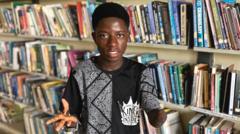
The BBC speaks to a student who pushed for his toe print to be taken to verify his identity.
Nigeria: 'I was tortured and lost my hand' - one student's struggle to get an education in Nigeria
Copyright current_year BBC. All rights reserved. The BBC is not responsible for the content of external sites. Read about our approach to external linking.
Copyright current_year BBC. All rights reserved. The BBC is not responsible for the content of external sites.
Read about our approach to external linking.
The fact that Ovey Friday is unable to provide thumbprints nearly cost him a place at university
Ovey Friday stands in front of book shelves in a library in Nigeria. He is wearing black and white T-shirt and a large watch. One of his hands has fingers missing. The other arm shows a scar where his hand was amputated
'I was tortured and lost my hand' - one student's struggle to get an education in Nigeria
At the age of 13, Ovey Friday was accused of witchcraft by his stepmother and taken to a traditional shrine in the central Nigerian state of Nasarawa, where he was tortured.
At the age of 13, Ovey Friday was accused of witchcraft by his stepmother
and taken to a traditional shrine in the central Nigerian state of Nasarawa, where he was tortured.
By the time a neighbour alerted police and he was taken to hospital, the damage was irreversible.
"The herbalist brought charcoal, put something on my hands, tied my hands [along] with my leg, put pepper there inside the charcoal, then cover[ed] me with a bedsheet," recalls Friday, now aged 19.
Doctors were forced to sedate him and operate on him. Friday woke up to find his left hand amputated, while the fingers on his right hand were either amputated or permanently scarred.
"I cried and I cried," Friday tells the BBC.
In the years that followed, people stared at him on the streets or taunted him.
"I wish they knew me, like, when I was born," he says.
Alongside his grief was a steely determination to keep going.
Yet his academic ambitions were nearly interrupted two years ago, when he tried to sit Nigeria's university entrance examination, run by the Joint Admissions and Matriculation Board (Jamb).
The system's biometric fingerprint process could not accommodate someone like him, as it could not capture his scarred thumbprint or the prints of the other two scarred fingers.
Thankfully he got lucky as one of his guardians, along with disability rights campaigners, pushed officials to accept his toe print as verification of his ID.
Friday is now studying English and literary studies at a university in Nasarawa, a state which borders the capital, Abuja.
Friday is now studying English and literary studies at a university in Nasarawa, a state which borders the
He is the first in his family to enrol at university.
"Not everyone has someone to push for them," he says. "Some people will just stop trying," Friday says.
Many apps do not facially recognise Scarlett Eduoku as she has a missing eye
Scarlett Eduoku, a radio presenter in the northern state of Kano, has faced similar obstacles and says most identity verification apps fail to scan her face. She lost her left eye when she was 18 months old.
This is a constant headache and also meant she could not upgrade her Sim card from 3G to 5G remotely.
Instead, she had to travel to the headquarters of her phone provider in Kano's city centre.
More than 35 million Nigerians, roughly 15% of the population, are estimated to live with some form of disability, according to the executive secretary of the National Commission for Persons with Disabilities (NCPWD), Ayuba Burki-Gufwan.
Landmark legislation was passed by parliament in 2019, prohibiting discrimination against disabled people and guaranteeing them access to public services.
The legislation led to the establishment of the NCPWD to advocate for their rights, but change has been "more or less at snail's speed", Burki-Gufwan tells the BBC.
He remains optimistic, however, saying that "the journey of a thousand miles begins with a step".
Burki-Gufwan points to some gains - Jamb has dropped examination fees for people with disabilities and has created dedicated centres for students with different needs.
A university in Nasarawa, the Federal University of Lafia, has also waived up to 75% of all fees for students living with disabilities.
"All of a sudden, the university witnessed a huge upsurge [in enrolment]," Burki-Gufwan says, "because every person with a disability wanted to benefit."
Lagos-based special educator Chukwuemeka Chimdiebere says Nigeria has to step up efforts to address the needs of disabled people.
"Inclusion is not a favour. It is a responsibility," he tells the BBC.
Accessibility, he explains, goes far beyond things like building ramps.
It means sign-language interpreters in classrooms, learning materials for visually impaired students, trained teachers and digital platforms designed with different users in mind.
"Many persons with disabilities are not limited by their impairment. They are limited by systems that were never designed with them in mind," Chimdiebere says.
"When I want to go out, I take someone with me so that when people start staring, start pointing, I don't notice. It's easier than facing it alone"", Source: Abiose Falade, Source description: An author based in Ibadan, Image:
Abiose Falade, 48, an author in the south-western city of Ibadan, uses a wheelchair and says that disability "is part of the circle of life".
"It can happen to you earlier, it can happen to you later. Sometimes it can be permanent, sometimes temporary. But disability is part of the dynamics of how God created us."
Falade did not see herself as being different from anyone else until she enrolled for school at the age of 10.
"I was introduced to the world and its intricacies," she says. "Persons with disabilities were not exactly part of what the world wanted."
She feels like this to this day: "There's a list of places I can go and a list I can't.
"When I want to go out, I take someone with me so that when people start staring, start pointing, I don't notice. It's easier than facing it alone."
The physical environment compounds the challenge.
In many Nigerian cities, pavements are uneven or interrupted by features like the wide gaps in open drainage channels designed for maintenance access, while dropped kerbs are few and far between, making them difficult or impossible to navigate. In rural areas, the absence of pavements means wheelchair users must rely on roads that are often unpaved or unsafe.
Public buildings rarely have ramps and wheelchair users struggle to enter banks, hospitals or government offices without assistance.
Making things worse is the fact that Nigeria has to import every wheelchair, hearing aid and mobility device.
"If nine out of every 10 person with disabilities requires some form of assistive device and none are locally manufactured, then we have a huge challenge on our hands," Burki-Gufwan says.
Advocates are calling for 1% of budgets to be reserved for persons with disabilities at every level of government. They say limited public funding and competing priorities affect how quickly accessibility measures can be implemented, even where there is willingness.
Expanding inclusive infrastructure and assistive technologies would require significant investment, though advocates says that stronger commitment and enforcement of existing laws are just as critical as funding.
Opeyemi Ademola says employers can implement simple techniques to help those like him with mixed hearing loss
Opeyemi Ademola, wearing glasses, seen in profile with a hand up to his head
Opeyemi Ademola, 28, a project manager in Lagos, has a disability which is not visible.
He lives with mixed hearing loss. So every meeting requires intense concentration, and noisy environments leave him mentally drained.
"People assume that if you can speak fluently, you don't experience communication challenges," he says.
"But accessibility is not about ability. It's about support."
Simple adjustments, like written summaries after meetings and captions on video calls, could make a big difference, he says.
Burki-Gufwan hopes that one day there will be "true accessibility" for people with disabilities.
"It means no-one is left behind - in employment, in education, in political participation," he says.
Back on campus, Friday is settling down as a student.
Between lectures and assignments, he is learning new ways to write again, to live independently away from home and to make new friends.
He is showing Nigerians that obstacles and prejudice can be overcome, and people with disabilities can succeed like everyone else if given the opportunity.
Lami Ezekiel in front of the home built for her by the government in the late 80s. She appears to be blind in one eye and is wearing a black and red floral dress, She is sitting on the ground next to a saucepan on a wood fire.
'We want a voice in our land' - the people evicted to build Nigeria's capital
Aliyu Abdullahi Isa, a Fulani herder wearing a white knitted hat. Behind him are white cattle grazing
'Peace is a gradual thing': How land, cattle and identity fuel a deadly Nigerian conflict
Two women, dressed as yellow flowers, smile at the camera, wearing sunglasses and petals
Carnival fever hits Lagos as locals celebrate Afro-Brazilian heritage
A woman looking at her mobile phone and the graphic BBC News Africa
Go to BBCAfrica.com for more news from the African continent.
for more news from the African continent.
Follow us on Twitter @BBCAfrica, on Facebook at BBC Africa or on Instagram at bbcafrica
Abubakar Malami was seen as one of the most influential ministers under former President Muhammadu Buhari.
Diezani Alison-Madueke is accused of living “a life of luxury” in the UK at properties paid for and refurbished by industry figures.
There are reports that more than 100 people were killed, although the authorities have not commented.
Bellarmine Mugabe was arrested in February following the shooting of a 23-year-old man at his home in Johannesburg.
Dolphin IV is the latest vessel to be operated by The Friends of Dolphin charity.
The comments follow a high-profile spat with US President Donald Trump, who called the Pope weak on crime.
Malema is appealing against the decision, which means he is not going to prison immediately.
The pontiff has been unusually forthright during his visit to conflict-hit Cameroon.