
World
Israeli air strikes hit Lebanese city of Tyre despite Iranian warning to stop attacks
June 9, 2026 International Source: BBC World
Iran warned Israel on Monday that it could resume hostilities if attacks on its Lebanese ally Hezbollah do not stop.
Israeli air strikes hit Lebanese city of Tyre despite Iranian warning to stop attacks
'Nowhere to go': Residents flee Tyre after Israeli warning
Copyright current_year BBC. All rights reserved. The BBC is not responsible for the content of external sites. Read about our approach to external linking.
Copyright current_year BBC. All rights reserved. The BBC is not responsible for the content of external sites.
Read about our approach to external linking.
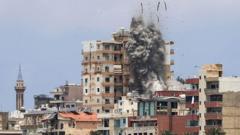
Smoke and debris rise following an Israeli air strike in Tyre, southern Lebanon (9 June 2026)
One Israeli air strike hit a residential building near Tyre's seafront
Israel has carried out strikes across southern Lebanon, despite a warning from Iran not to continue attacks in the country.
The Lebanese health ministry said eight people were killed in Tyre, where the Israeli military issued a new order for residents to leave the southern city, including its Christian quarter for the first time.
Israel and Iran paused hostilities on Monday, after an Israeli strike on Beirut targeting the Iranian-backed armed group Hezbollah triggered their first exchange of fire since a truce in April.
Iran warned that it could hit Israel again if it did not stop attacks in Lebanon. But Israel vowed to continue its campaign against Hezbollah.
The conflict is complicating President Donald Trump's efforts to strike a deal to end the war between the US, Israel and Iran.
A woman looks at the rubble of her house, which was damaged in a U.S. and Israeli strike in March, in Tehran, Iran June 7, 2026
Israel and Iran flare-up could strengthen Tehran's negotiating hand
Israeli settlers use a tractor to haul away a large section of a downed Iranian missile toward their farm on June 8, 2026 on the outskirts of Jericho, Israel.
Iran and Israel say they will pause strikes but warn of retaliation if ceasefire breached again
Lebanese media reported that Israeli air and artillery strikes across southern Lebanon killed at least 13 people on Tuesday.
Two people were killed in a pre-dawn drone attack in Kfar Roummane, next to the major town of Nabatieh, according to the state-run National News Agency (NNA).
Later, the Israeli military again told residents of Tyre and its surrounding area to leave their homes immediately and move beyond the Zahrani river, about 30km (20 miles) to the north.
But for the first time, the evacuation order included the Christian quarter, in the city's north-west, where the military alleged that Hezbollah fighters were operating last week.
Roads heading north were busy as residents fled in response to the warning, with mattresses and bags tied to car roofs.
Among them was Elias Barbour, who said he was going to his sister's home in Beirut.
"What have we done wrong? What are we supposed to do?" he told AFP news agency.
Mohammed Mustafa, who was heading to Sidon with his daughter, said he did not want to go.
"It's a lie when they say Hezbollah is here... This is a lie to scare people," he added.
The Israeli military posted its order on social media minutes after reports emerged of air strikes on several buildings in Tyre's eastern al-Massaken al-Shaabiya area.
The Lebanese health ministry said at least eight people were killed and 32 were injured, but added that the figures were provisional because rescuers were still searching through rubble.
In the afternoon, two Syrian nationals were killed in Israeli strikes in the villages of Ansariyeh and Aadloun, which are on the coastal highway north of Tyre, according to NNA.
There was no immediate comment from the Israeli military.
However, the Israeli military's chief of staff, Lt Gen Eyal Zamir, said Israeli forces continued to operate in several areas of southern Lebanon and were dismantling Hezbollah infrastructure.
The Israeli military also said in a separate statement that troops operating in the Ramim Ridge area of northern Israel's Galilee region had shot dead a "terrorist" who crossed into Israeli territory from Lebanon and opened fire towards them.
Hezbollah said on Tuesday that its fighters had launched rockets at a new Israeli military site in the southern border town of Maroun al-Ras, and targeted Israeli troops and military vehicles further north in Qantara and Zawtar al-Sharqiyeh with attack drones.
Map showing an area of southern Lebanon around the coastal city of Tyre shaded in red to indicate area the Israel Defense Forces are saying must be evacuated, extending inland to Bork El Chmali and south towards Rachidiyeh. An inset map locates the area within Lebanon, near the border with Israel.
Lebanon was drawn into the war between Israel, the US and Iran on 2 March, when Hezbollah launched rockets into Israel in retaliation for an Israeli strike that killed Iran's supreme leader.
Israel responded by launching a bombing campaign across Lebanon and invading a significant part of the country's south.
Lebanon's health ministry says at least 3,666 people have been killed there, while Israeli authorities say 30 soldiers and four civilians have been killed on both sides of the border.
Almost one million people in Lebanon - a fifth of the population - remain displaced from their homes and that 1.4 million need humanitarian aid, according to the UN.
The US brokered a ceasefire deal between the Israeli and Lebanese governments on 16 April, but the conflict has continued since then.
The escalation between Israel and Iran began on Sunday.
It followed an Israeli strike in Beirut's southern suburbs - a stronghold of Hezbollah also known as Dahieh - after the group fired two rockets over the border.
Iran fired some 30 ballistic missiles at Israel, while Israel said it carried out two waves of air strikes on Iran. Two Iranian officers were killed, according to Iran's state broadcaster.
On Monday, Iran's armed forces announced that they had stopped operations after delivering a "painful response" to Israel. They also pledged "more severe and crushing measures" if Israel carried out more attacks, including in Lebanon.
Israeli Prime Minister Benjamin Netanyahu said his country was holding fire "at the moment". But he stressed that the struggle against Iran and Hezbollah was "not finished" and warned that Israel would "respond with overwhelming force" to another Iranian attack.
"Iran's attempt to dictate new rules and alter the reality will fail. We will continue to operate and deepen the damage inflicted on the Hezbollah terrorist organisation while defending the communities of northern Israel," Gen Zamir told Israeli military commanders on Tuesday.
Israel's PM says his country is holding fire "at the moment", after Iran's armed forces said they had stopped military action.
Iran appears emboldened by the outcome and its leaders may sense Trump's appetite for risk is low.
The Israeli military is investigating the incident in south Lebanon, where it is fighting Hezbollah.
President Donald Trump earlier accused Iran of shooting down the US helicopter over the Strait of Hormuz and vowed to respond.
The uncrewed vessel - which looks similar to a speedboat - rescued the two soldiers from an Apache helicopter that went down on Monday.
France will also bar far-right Israeli Minister Bezalel Smotrich from entry as part of the measures, which Israel condemns as "disgraceful".
The US and Israeli leaders have lost control of the consequences after miscalculating the Iran war.
Fifa has said it is working to "maximise opportunities for Iranian supporters to attend matches" after the country's World Cup group-stage ticket allocation was revoked just days before the tournament.