
World
Israeli strikes in southern Lebanon kill 17, reports say
June 10, 2026 International Source: BBC World
Nine of them were killed in a series of attacks in the town of Tayr Debba, according to Lebanon's state news agency.
Israeli strikes in southern Lebanon kill 17, reports say
Copyright current_year BBC. All rights reserved. The BBC is not responsible for the content of external sites. Read about our approach to external linking.
Copyright current_year BBC. All rights reserved. The BBC is not responsible for the content of external sites.
Read about our approach to external linking.
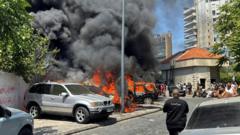
Two people were reportedly killed in a strike on a car in the southern city of Sidon
Smoke rises from burning vehicles following an Israeli strike in the centre of the city of Sidon, southern Lebanon (10 June 2026)
Israeli air strikes have killed at least 17 people in southern Lebanon, Lebanese media say.
Nine people were killed in a series of strikes in the town of Tayr Debba, according to Lebanon's state-run National News Agency (NNA).
Meanwhile, the Iranian-backed armed group Hezbollah said it carried out more attacks on Israeli troops occupying parts of the country's south.
On Tuesday, 15 people were reportedly killed in Israeli strikes in Lebanon, as Israel rejected a warning from Iran not to continue its campaign against Hezbollah.
Iran's leaders are demanding that any deal to end its war with the US and Israel also covers Lebanon, complicating negotiations with US President Trump.
Close up shot of Trump stood pointing while speaking to reporters on Air Force One
Trump and Iran trade new threats after strikes exchanged
A composite image shows President Donald Trump on the left holding a finger up and wearing a suit, shirt and tie as he speaks to reporters. On the right Prime Minister Benjamin Netanyahu also wears a suit, shirt and tie and interlaces his fingers as he speaks during a press conference.
Bowen: Trump and Netanyahu wanted to reshape the Middle East - now they risk a permacrisis
Smoke and debris rise following an Israeli air strike in Tyre, southern Lebanon (9 June 2026)
Israeli air strikes hit Lebanese city of Tyre despite Iranian warning to stop attacks
NNA reported that Israeli air and artillery strikes intensified across the south of the country on Wednesday, with attacks in a number of cities, towns and villages.
It said nine people were killed when Israeli jets and drones carried out at least four strikes in Tayr Debba, just east of the port city of Tyre.
Two Israeli strikes killed three other people in the nearby village of Deir Qanoun el-Nahr, while two people were killed in Seddiqin, south-east of Tyre, it added.
Later, there was an attack in the centre of the city of Sidon, which is located on the coast roughly halfway between Tyre and the capital Beirut.
An AFP news agency correspondent said they heard an explosion before seeing a car burning. Two people were pulled from the vehicle by rescuers, they added.
NNA said the car was targeted by an Israeli drone and that the two people died.
One person was also reportedly killed in the Massaken al-Shaabiya area of Tyre.
On Tuesday, Israeli strikes in Massaken al-Shaabiya and elsewhere in Tyre killed 11 people, the Lebanese health ministry said, as the Israeli military issued a new evacuation order for the city that included its Christian quarter for the first time.
There was no immediate comment from the Israeli military on Wednesday's strikes, but it issued a statement earlier saying it had struck six Hezbollah infrastructure sites in Tyre and ready-to-use Launchers in several other areas of southern Lebanon on Tuesday.
Hezbollah announced that its fighters had targeted gatherings of Israeli troops and military vehicles in the southern Bayada and Yohmor areas with rocket barrages and shellfire.
Meanwhile, UN human rights chief Volker Türk announced on Wednesday that he was sending a team of human rights investigators to Lebanon, at the request of the Lebanese government.
The team will look at possible human rights violations committed by all sides since the start of March, and is expected to present its findings at the end of July. Evidence gathered could be used in possible prosecutions for war crimes.
Israel has been informed of the mission, but it remains unclear whether it will co-operate.
Lebanon was drawn into the war between Israel, the US and Iran on 2 March, when Hezbollah launched rockets into Israel in retaliation for an Israeli strike that killed Iran's supreme leader.
Israel responded by launching a bombing campaign across Lebanon and invading a significant part of the country's south.
Lebanon's health ministry says at least 3,696 people have been killed there during the conflict, while Israeli authorities say 30 soldiers and four civilians have been killed on both sides of the border.
Almost one million people in Lebanon - a fifth of the population - remain displaced from their homes and that 1.4 million need humanitarian aid, according to the UN.
The US brokered a ceasefire deal between the Israeli and Lebanese governments on 16 April, but the conflict has continued since then.
The exchange of fire between Israel and Iran – their first in two months - was triggered by events in Lebanon.
On Sunday, Israel struck Beirut's southern suburbs - a stronghold of Hezbollah also known as Dahieh - after the group fired two rockets over the border.
Iran fired some 30 ballistic missiles at Israel in response, while Israel said it carried out two waves of air strikes on Iran.
After a tense calm was restored on Monday, Iran warned it would resume hostilities if Israel continued to attack Lebanon. But Israel insisted it would not accept a "new equation" and that it would continue to operate against Hezbollah.
Iran warned Israel on Monday that it could resume hostilities if attacks on its Lebanese ally Hezbollah do not stop.
Israel's PM says his country is holding fire "at the moment", after Iran's armed forces said they had stopped military action.
Iran appears emboldened by the outcome and its leaders may sense Trump's appetite for risk is low.
France will also bar far-right Israeli Minister Bezalel Smotrich from entry as part of the measures, which Israel condemns as "disgraceful".
The US and Israeli leaders have lost control of the consequences after miscalculating the Iran war.
Iran's decision to risk jeopardising peace talks may reflect how its leaders view their current position, writes BBC Persian editor Amir Azimi.
The BBC's international editor, Jeremy Bowen, said the public are "right to be worried" as the consequences of the war will be felt for generations.
Israel says the attacks on the Lebanese capital were ordered "in response to Hezbollah's firing at Israeli territory".