
World
Mother finds body of missing son two days after Kenya's Ebola quarantine centre protests
June 12, 2026 International Source: BBC World
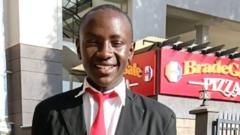
Sylvester Muigai Ndung'u was in Nanyuki to fetch a school uniform on Tuesday, his mother says.
Kenya Ebola quarantine centre: The identity of a third person killed in protests confirmed
Copyright current_year BBC. All rights reserved. The BBC is not responsible for the content of external sites. Read about our approach to external linking.
Copyright current_year BBC. All rights reserved. The BBC is not responsible for the content of external sites.
Read about our approach to external linking.
A photograph of Sylvester Muigai Ndung'u in a school uniform. He is in a grey jacket, white shirt and red tie.
Mother finds body of missing son two days after Kenya's Ebola quarantine centre protests
Sylvester Muigai Ndung'u's mother said he went out on Tuesday to collect his school uniform from his aunt
The mother of teenager Sylvester Muigai Ndung'u found his body in a mortuary in the central Kenyan town of Nanyuki two days after he went missing.
Warning: This article contains details some readers may find upsetting.
The 17-year-old was killed on Tuesday in clashes between police and demonstrators during a protest over a US plan to build an Ebola quarantine centre at a nearby military base.
Lucy Kagure had been searching for her son in hospitals and police stations and eventually discovered his body at the mortuary, where he was listed as an unidentified male.
"When I found him, half of his head had been split open. His clothes were soaked in blood," she told the BBC.
Witnesses said Muigai had been shot in the head, but a local police commander, Daniel Kitavi, told the BBC that the authorities were still waiting for a post-mortem to determine the cause of death.
Lucy Kagure has accused the police of using "too much force" to deal with the protests
A head and shoulders image of Lucy Kagure, who is crying. She is wearing a sports top.
Family members say police officers suggested he may have been killed by a tear-gas canister rather than a bullet.
Kagure said her son had left home on Tuesday to collect his school uniform from his aunt when he got caught up in the unrest.
"The police used too much force," she said through tears. "Are they not parents too?
"I have struggled to raise that boy as a single mother, earning just 300 [Kenya] shillings ($2.30; £1.70) a day doing casual work," she said.
"I brought him up from nursery school to form three, and then they just killed him."
His family described the teenager as a well-behaved boy who was always helping out at home.
A leader in the local church said he had ambitions of becoming a priest.
Muigai is the third person to have died amid protests against the planned 50-bed quarantine centre.
The isolation unit at the Laikipia Air Base is intended for US citizens affected by the current Ebola outbreak in the Democratic Republic of Congo.
The plan has sparked public concern in Kenya about cross-border infection risks and the lack of transparency from the government about the treatment centre.
Last month, the High Court said the opening of the facility should be halted after a rights group opened a case alleging it posed "grave and imminent risks" to public health.
Satellite imagery seen by the BBC show that construction has continued at the airbase despite the court halting it.
Protesters in Nanyuki said there was a lack of transparency over the building of the quarantine centre
Protesters carry a white coffin, with the word "Ebola" in red paint on the side. They are also holding placards saying - in Swahili - "we reject Ebola" and - in English: "Public trust requires transparency".
The US official last week said the administration was aware of the court case but "optimistic we can resolve objections".
Kenya's President William Ruto defended the plan, saying he had received a request from the US to establish the centre and a refusal would be "inhuman".
He called on Kenyans not to politicise a matter "so serious" as Ebola, asking politicians to avoid "reckless" talk about it.
On Tuesday, demonstrators had planned a peaceful march to deliver a petition calling for the facility to be relocated. But clashes broke out after police blocked access to the site.
Police used tear gas and water cannon to disperse crowds, while protesters erected roadblocks and lit bonfires across parts of the town.
The Kenya Human Rights Commission, a non-governmental organisation, has accused police of using excessive force, including live ammunition and arbitrary arrests during the demonstrations. The authorities have not responded to those allegations.
But a mourning mother now wants answers.
More from the BBC on the Ebola outbreak:
A health worker in full PPE - white suit and green rubber gloves - crouched on the right of a wooden coffin with gold handles
How health workers in DR Congo are treating Ebola and staying safe
The image depicts a group of individuals dressed in full-body protective suits, complete with face masks, goggles, and bright orange gloves. Their attire suggests they are engaged in a high-risk operation, likely involving hazardous materials or infectious disease control. They are working outdoors in what appears to be a forested or rural environment, with greenery and natural terrain surrounding them. The scene conveys a sense of urgency and seriousness, as the protective gear is designed to minimise exposure to dangerous contaminants.
'Speed, money and compassion' - lessons from an Ebola survivor and other experts
A person in PPE and full head covering is having their goggles adjusted by someone, with blue protective gloves, out-of-focus in the foreground. The green scrubs and hair covering of that person can be seen on the right of the picture.
What is Ebola and why is stopping the latest outbreak so difficult?
A woman looking at her mobile phone and the graphic BBC News Africa
Go to BBCAfrica.com for more news from the African continent.
for more news from the African continent.
Follow us on Twitter @BBCAfrica, on Facebook at BBC Africa or on Instagram at bbcafrica
Bola Tinubu was addressing the nation on Democracy Day, marking the return to civilian rule in 1999.
Southwark Council in south London takes possession of a property linked to Sierra Leone's Fatima Bio.
An outbreak of Ebola in DR Congo involves a rare species of the virus and is in an area affected by conflict.
Protesters are concerned about cross-border infection risks and the lack of transparency from the government about the treatment centre.
The decision weakens Rigathi Gachagua's bid for the presidency, although his lawyers have vowed to challenge the ruling.
Activists allege there is a plan to build a car park on protected land belonging to a wildlife sanctuary.
There are now 380 confirmed cases of Ebola in DR Congo, far lower than initial estimates of suspected cases, writes Fergus Walsh.
The US plan has sparked public anger and led to demonstrations near the site of the proposed treatment facility.