
Sports
Scotland boss Clarke by those who know him best
June 12, 2026 Sports Source: BBC Sports
BBC Homepage Skip to content Accessibility Help Your account Home News Football 2026 Business Technology Health Culture Arts Travel Earth Sport Audio Video Live More menu More menu Search BBC Home News Football 2026 Business Technology Health Culture Arts Travel Earth Sport Audio Video Live Close menu BBC Sport Menu Home World Cup Football Cricket Formula 1 Rugby U Tennis Golf Cycling Athletics More A-Z Sports American Football Athletics Basketball Boxing Cricket Cycling Darts Disability Sport Football Formula 1 Gaelic Games Golf Gymnastics Horse Racing Mixed Martial Arts Motorsport Netball Olympic Sports Rugby League Rugby Union Snooker Swimming Tennis Full Sports A-Z More from Sport England Scotland Wales Northern Ireland News Feeds Help & FAQs Scotland Men's Scores & Fixtures Women's Scores & Fixtures Men's Table Women's Table Scottish Football Scotland boss Clarke by those who know him best
Image source, SNS By Thomas Duncan BBC Sport Scotland Footage from the Scotland changing room after the win over Denmark says a lot about Steve Clarke.
Players and staff line the edge of the Hampden changing room, some standing on the benches and peering over shoulders to get a glimpse of the head coach as he makes his speech.
There are celebratory t-shirts on and hands wrapped around bottles of beer, but in the moment the party is suspended as all eyes fix on him.
There is a hint of emotion in Clarke's voice, but he is calm as he lays out just how significant Scotland's achievement is: qualifying for a first men's World Cup since 1998. Players barely move.
Until Clarke reveals they are free to hit up one of Glasgow's main bars, that is. Then there is a wide smile and bedlam.
To those that know and work with the Scotland boss, that small moment probably encapulates his traits. Calm, measured, with a hint of humour piercing a sometimes stony exterior.
The 62-year-old from Saltcoats has his detractors, but has become Scotland's most capped and perhaps most successful manager.
Two European Championships and now World Cup qualification, given what he inherited, speaks for itself. His rise to a legendary perch in Scottish football has been steady and understated, which is probably fine by him.
Why this World Cup will showcase 'different Steve Clarke'
Published 2 days ago You are Steve Clarke... what would you do against Haiti?
Published 4 hours ago From risk of death to the oldest man at World Cup
Published 3 days ago 'When he said something, people shut up' Clarke has been characterised most of his professional life as a man of few words.
His sometimes short, clipped answers to journalists' questions and tendency not to smile too much means he has taken on the stereotype of a dour Scotsman.
Of course, that impression is not a full picture. But while that characterisation may be cartoonish, it does come from somehwere.
As a manager Clarke has said himself he does not like to get too close to his players, preferring to rely on senior squad members to run the dressing room.
That was Gary Dicker's experience when playing for Clarke at Kilmarnock between 2017 and 2019. The former midfielder said the manager did not speak much during his first six months in charge, but his impact was significant.
"He only spoke when he needed to but I think he was scanning and picking up everything he needed to and getting to know the place and the players," Dicker said.
By using praise and criticism sparingly, Clarke created an environment where every single player wanted to impress him.
His presence influenced the group, without the need for words. Kilmarnock went from fighting relegation, to European football.
McGinn in the form of his life and now dancing to Scotland's tune
Published 3 days ago Inside the fairytale journey of Scotland captain Robertson
Published 4 days ago Pat Nevin, a friend of Clarke's from their time at Chelsea, said he was the same as a player. "When he said something everyone shut up and listened," he explained.
Every Scotland player was certainly listening quietly when Clarke addressed them at the team hotel before the Denmark game.
The normally stoic head coach felt now was the time to use the power of emotion as they prepared for the biggest match of their seven years together.
Players said he tapped into his own background and story, taking them through the ups and the downs. He described the journey the group had been on, culminating in this incredible opportunity to go to the World Cup.
"When he was finished, a lot of boys jumped off their seats and were ready to go to war," Ryan Christie said.
"I was nearly in tears, man, honestly," Scott McTominay recalled.
It is an instructive example of Clarke's emotional intelligence and ability to get the best from a group of players. Do not mistake stoicism on the outside for a lack of feel for the moment.
Plenty of people who know Clarke also talk about his dry wit and humour, too.
That does flicker in front of the cameras at times but is only properly felt in his company. John McGinn, one of the squad's biggest personalities, insists Clarke "likes a laugh" despite appearances sometimes.
"I think after the Denmark game was one of the rare times I've seen him properly smiling and enjoy himself a little bit, which was cool to see," Christie said.
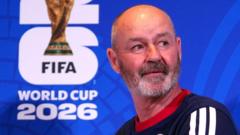
Image source, SNS Image caption, Clarke showed his softer side after Scotland defeated Denmark to reach the World Cup
When Clarke took charge of Scotland in 2019, the national team had secured a Nations League play-off route to Euro 2020 but still felt a long way from ending their major finals drought.
A 3-0 defeat in Kazakhstan in Euro 2020 qualifying cost Alex McLeish his job and Clarke was charged with turning around a squad haunted by failures of the past.
His belief from the start was that he needed to form a core group, let them grow together and build up the experience required to challenge for major tournament qualification.
Captain Andy Robertson, McGinn, McTominay, Kenny McLean, John Souttar, and Scott McKenna were all in Clarke's first squad in 2019 and are in the World Cup group. Only Souttar, due to injury, has fewer than 50 caps.
Others such as Grant Hanley, Kieran Tierney, Che Adams, Ryan Christie, Billy Gilmour and Lyndon Dykes have been pivotal. Plenty of players have been backed to play for Scotland even amid loss of form or injuries.
Both Clarke's biggest supporters and ardent critics mention the world loyalty when describing him. For the critics it is stubborn loyalty to certain players. For his supporters it is a tenet of his personality.
"Sometimes, I get criticised for not going outside that core group but I believe in them a lot and they've delivered a lot for their country," he said.
Clarke only played for two clubs in his professional career. After five years at St Mirren, he played 421 times for Chelsea and won an FA Cup and European Cup Winners' Cup in the 1990s.
Long-term relationships and stability have always been important to him. During his seven years as Scotland boss, that investment in the same group has paid off.
To play this video you need to enable JavaScript in your browser. This video can not be played
Former Scotland assistant coach Steven Reid worked with Clarke at Reading, and once described how his boss moved a cone he had placed for a training drill by a matter of inches.
Plenty who have seen him on the training ground talk about his attention to detail, and Clarke himself says he is at his most content delivering sessions.
Jose Mourinho, Kenny Dalglish, and Ruud Gullit all hired him as a coach before he made a belated move into management with West Brom at 48 years old.
Dicker said Clarke's coaching left "no grey areas" for the Kilmarnock squad during his impressive spell at Rugby Park.
His ability to bring a squad close together with clear instructions as been a hallmark of his management, even though Clarke is sometimes criticised for his conservative approach.
Those critics were loudest when Scotland failed to get out of their Euro 2024 group, losing to Hungary in their final group game without managing a shot on target.
Scotland have not won any of their matches at their two previous major finals.
It meant news of a four-year deal on the eve of the World Cup was not universally welcomed. Some would have preferred his future was decided after returning from the United States. But it was clear the players wanted him to stay.
Clarke pushes back at suggestions that he is not adaptable. Given he has changed formations regularly, and evolved the squad slowly over time you can see why.
When hit with setbacks he has come up with solutions, perhaps while on some of his beloved fly fishing trips.
After initially being deployed as a centre-back, McTominay became a goalscoring midfielder for Clarke before his ascent in a similar role for Manchester United and Napoli.
Another example is bringing in winger Ben Gannon-Doak despite his limited experience, which transformed Scotland's 2024 Nations League campaign. The Bournemouth youngster has been a key player since.
"I think I've shown consistently throughout my time that I'm prepared to try something different," Clarke told BBC Scotland.
He has struck a more relaxed done in the build-up to World Cup, citing lessons learned from the disappointing European Championships.
Clarke will have to channel his coaching skills, human touch, and experience to become the first Scotland manager to guide a side to the knockout stage of a major finals.
As he writes the next chapter in his career, that would be the perfect beginning.
Everything you need to know about the World Cup
Home News Football 2026 Business Technology Health Culture Arts Travel Earth Sport Audio Video Live Terms of Use About the BBC Privacy Policy Cookies Accessibility Help Parental Guidance Contact the BBC BBC emails for you Advertise with us Copyright © 2026 BBC. The BBC is not responsible for the content of external sites. Read about our approach to external linking.