World
Trump heralds Iran deal but questions - and risks - remain
June 15, 2026 International Source: BBC World
The announcement of an Iran deal was a welcome birthday gift for the president – but its success or failure may hinge on the details.
Trump's Iran announcement may ease pressure but uncertainty lingers
Watch: Trump tells BBC Netanyahu did not defy him
Copyright current_year BBC. All rights reserved. The BBC is not responsible for the content of external sites. Read about our approach to external linking.
Copyright current_year BBC. All rights reserved. The BBC is not responsible for the content of external sites.
Read about our approach to external linking.
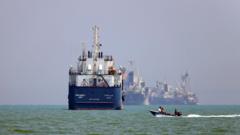
Close up of large tankers and boats in the the Strait of Hormuz
Trump heralds Iran deal but questions - and risks - remain
Vessels at the Strait of Hormuz, as seen from Musandam, Oman, on Sunday
The Strait of Hormuz is shown from a dsitance w several tankers and freight boats. There are mountains in the foreground and in the distance.
The announcement of a deal to end hostilities between the US and Iran has provided Donald Trump with a very welcome birthday present – although it's wrapped in a fair measure of uncertainty.
The US president said in his social media post heralding the agreement that the Strait of Hormuz would be open to commercial shipping and the US would lift its naval blockade.
"Let the oil flow!" Trump exclaimed on Sunday.
He went on to declare that, in contrast with the failures of past US presidents, he secured a "great deal" that would bring "peace and security to the whole region".
Such hyperbole is nothing new for Trump, of course. His declarations about last year's agreement ending the Gaza War – "a peace for all eternity" and the "beginning of the age of faith and hope and of God" - were equally sweeping, even as the reality on the ground has fallen far short.
Why the US economy keeps defying the odds
In such high-stakes diplomatic agreements, success or failure usually hinges on the details. And here, the details are scarce.
US Vice-President JD Vance said in a Sunday evening interview with Fox News that Iran never possessing a nuclear weapon was "built into this agreement" and that the US will be able to verify compliance.
Yet questions remain over crucial issues including what the restrictions on enrichment will be and what should happen to the stockpile of highly enriched uranium Iran has now.
Some of this is sure to be worked out in subsequent negotiations and "technical" talks conducted during a 60-day extension of the current ceasefire. But if anything is clear after decades of efforts to cajole and coerce Iran into giving up its nuclear ambitions, it's that there are no guarantees, no matter what the US believes is secured in this "memorandum of understanding".
As if to underscore this point, Iran's Supreme National Security Council released a statement on Sunday saying that "final negotiations will be postponed until after the implementation of the other party's commitments under the memorandum".
What those commitments are - and how Iran interprets them - will help determine whether this deal sticks.
Energy market experts warned that moving of oil through the strait is unlikely to immediately return to pre-war levels. Clearing a large backlog of tankers, removing mines and restoring regular oil shipping and production could take weeks.
With several days to go before the official signing, Iran and the US have time to settle key details to ensure the deal's success - but there's also time for it to fall apart.
This was always a three-party war, and Trump told the Wall Street Journal on Sunday that he was furious at Israeli Prime Minister Benjamin Netanyahu for ordering strikes on Lebanon this weekend that he believed might torpedo the almost-completed Iran deal.
Split screen of a woman in a yellow blazer at a desk and a man in a blue blazer with flags behind him.
The deal held – at least long enough for it to be publicly announced. But if Israel begins new military operations in Lebanon, Iran could decide to close Hormuz again and again jeopardise the global economy.
In his comments, Vance also acknowledged the pain this war has caused many Americans because of higher energy prices and their knock-on economic effects.
"My primary message to the American people is thank you," he said, as he promised that energy prices would start coming down.
How quickly that happens, and how quickly that translates into lower consumer costs across the board for Americans confronting financial hardships, will go a long way in determining whether the growing political pressure on Republicans abates before November's midterm congressional elections.
Trump and his party are facing an increasingly restive public, recent polling suggests. A YouGov survey found that 63% of Americans disapprove of his handling of the economy, with 57% feeling the economy was getting worse.
At minimum, however, Sunday's deal should help alleviate, if not entirely remove, some of the economic strain from the ongoing conflict. If petrol prices start dropping in earnest, it could be a tangible sign for Americans that things are getting better.
It's a notable step towards the way things were before the start of the war, even if Trump's larger goals remain unrealised for now and he still faces political peril at home.
Your Voice banner image. Your Voice is written in white against a purple background.
Please include a contact number if you are willing to speak to a BBC journalist. You can also get in touch in the following ways: Email: yourvoice@bbc.co.uk WhatsApp: +44 7756 165803 Tweet: @BBC_HaveYourSay And you can send us a video note via WhatsApp or by using this link .
A petrol station worker fills the tank of a customer's vehicle in Peshawar, Pakistan, 3 April 2026.
Oil prices slide after Pakistan announces deal between US and Iran
Police officers and emergency personnel work at the site of an Israeli strike on Beirut's southern suburb of Dahieh, Lebanon. Photo: 14 June 2026
Israeli military says Hezbollah targets struck in Beirut
Split screen. Left, Donald Trump. Right, Gary O'Donoghue.
Flip flop or deliberate? - Unpacking Trump’s strategy on Iran
Split screen. Left, Donald Trump. Right, inside SoFi Stadium.
Watch: Why is Trump not at the World Cup?
Split screen. Left, Donald Trump. Right, inside the SoFi Stadium.
A thin, grey banner promoting the US Politics Unspun newsletter. On the right, there is an image of North America correspondent Anthony Zurcher, wearing a blue suit and shirt and grey tie. Behind him is a visualisation of the Capitol Building on vertical red, grey and blue stripes. The banner reads: "The newsletter that cuts through the noise.”
Follow the twists and turns of Trump's second term with North America correspondent Anthony Zurcher's weekly US Politics Unspun newsletter. Readers in the UK can sign up here. Those outside the UK can sign up here.
Follow the twists and turns of Trump's second term with North America correspondent Anthony Zurcher's weekly US Politics Unspun newsletter. Readers in the UK can
Both sides declare "the immediate and permanent termination of military operations on all fronts, including in Lebanon", Pakistan says.
Iran's striker Mehdi Taremi said the country's political predicament "undermines the joy of the World Cup".
BBC's Sebastian Usher on the deal announced by the US and Iran on Sunday.
Justin Gaethje beat Ilia Topuria to win the lightweight championship in the main event.
Under the agreement, the key Strait of Hormuz waterway will be reopened, US President Donald Trump said.
Pakistan says the deal includes Lebanon, but recent ceasefires there have failed to take hold.
Israel says it targeted the Iran-backed armed group Hezbollah, as Tehran warns this could derail a US-Iran deal to end the fighting.
The US president's comments come as Iran says an exact date has not been decided.