World
Trump says deal to end war with Iran already signed and details to be released 'pretty soon'
June 16, 2026 International Source: BBC World
Trump says Strait of Hormuz will be open from Friday but there is still confusion about the exact contents of the agreement.
Trump says deal to end war with Iran already signed and details to be released 'pretty soon'
What does the US-Iran deal mean for Lebanon and Israel?
Copyright current_year BBC. All rights reserved. The BBC is not responsible for the content of external sites. Read about our approach to external linking.
Copyright current_year BBC. All rights reserved. The BBC is not responsible for the content of external sites.
Read about our approach to external linking.
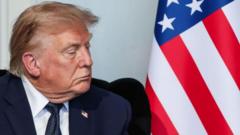
US President Donald Trump attends a bilateral meeting with French President Emmanuel Macron
Close up of US President Donald Trump and an American flag as he attends a bilateral meeting with French President Emmanuel Macron
US President Donald Trump has said a preliminary deal to end the war with Iran has already been signed and suggested that details of the agreement are set to be published "pretty soon".
"I am very happy to say it's signed, the deal is all signed," he said during talks with French President Emmanuel Macron at the G7 summit on Monday.
Senior US officials also began giving some details about the contents of the deal, briefing that the Strait of Hormuz would re-open on Friday - the same day the deal is formally inked in Geneva.
Technical talks on Iran's nuclear programme are expected to begin this week, they said, while any sanctions relief or release of assets will depend on Iran meeting commitments under the deal.
How could the US-Iran deal affect oil prices and the cost of food?
Iranians walk past a billboard of the late Iranian supreme leaders, 15 June
Bowen: Iran deal ends Trump's war that revealed limit of US dominance
The US officials said the agreement had been signed electronically by Trump, Vice President JD Vance and Iranian Parliament Speaker Mohammad Bagher Ghalibaf.
They also suggested more details of the pact could be released by Wednesday - although Trump said the full text of the agreement would be released "pretty soon" after Friday's ceremony.
"It's a very powerful document, and I want it to be released. So probably pretty soon," the president said.
The deal will extend a ceasefire for another 60 days, during which the sides will negotiate details of a final agreement.
Announcing the breakthrough on Sunday, Pakistan's Prime Minister Shehbaz Sharif, whose nation had been mediating, said it included "the immediate and permanent termination of military operations on all fronts, including in Lebanon".
The US officials said that while Lebanon was covered by the ceasefire framework, the withdrawal of Israeli forces from Lebanese territory was not a condition of the deal. Israel would retain the right to self defence, they added.
Speaking on Monday evening, Israeli Prime Minister Benjamin Netanyahu said Israeli forces would remain in security zones in Lebanon, Syria and Gaza "as long as necessary", and retain the freedom to act against attacks.
He also told a news conference Iran would not be allowed to obtain nuclear weapons, with or without a deal.
Mr Netanyahu was speaking after Lebanese media reported a deadly Israeli strike on a car in the south - the first since the peace deal was announced. Hezbollah said it had fired missiles and drones at Israeli forces in return.
Watch: What does the US-Iran deal mean for Lebanon and Israel?
Israeli Prime Minister Netanyahu holds news conference after US-Iran agreement, Jerusalem - 15 Jun 2026
Iran deal presents political nightmare for Netanyahu
Trump on Sunday said he had ordered the immediate removal of a US naval blockade of Iranian ports and added that the Strait of Hormuz would be opened when the initial agreement was signed.
Taking to social media on Monday, he claimed that "ships are starting to move, many loaded up with Oil, out of the Strait of Hormuz".
Iran's deputy foreign minister Kazem Gharibabadi confirmed the end of military operations in a phone call on Iranian state TV, which portrayed the framework deal as a victory for Iran.
Gharibabadi said that Qatari mediators held "nearly 14 to 15 hours of lengthy talks" in Tehran to reach the initial agreement.
Iran's top military command, Khatam al-Anbiya Central Headquarters, said that Iranians, together with the country's armed forces and Tehran's proxies and allies in the region, had shown the US and Israel that they had "no option but to accept defeat and surrender".
But Iran's foreign ministry said Tehran still held "deep mistrust" of the US and the agreement was "merely a step towards reducing tensions".
Lebanese President Joseph Aoun welcomed the announcement, saying in a statement that he looked forward to the understandings translating into "practical steps that will put a definitive end to the cycle of violence".
Key past sticking points have included Iran's nuclear enrichment and Western insistence that the country not possess a nuclear weapon, and Iran's desire for comprehensive sanctions relief and access to tens of billions of dollars in frozen oil revenues.
JD Vance told Fox News on Sunday that Iran never possessing a nuclear weapon was "built into this agreement" and that the US will be able to verify compliance.
In a congratulatory joint statement, the leaders of the UK, France, Germany and Italy said Iran "must never acquire a nuclear weapon" and that they were "prepared to lift relevant sanctions in response to clear, verifiable steps by Iran on its nuclear programme".
UK Prime Minister Sir Keir Starmer called the announcement "a hugely important step forward in ending the war, ensuring regional stability and re-opening the Strait of Hormuz".
Donald Trump wearing a suit and standing at a podium with the president’s seal. He is looking to his right and pointing with his index finger
Trump aims to end Iran war but nuclear issue remains unresolved
Close up of large tankers and boats in the the Strait of Hormuz
Trump heralds Iran deal but questions - and risks - remain
The BBC's Gary O'Donoghue looks at the contrasting approaches of the two presidents as Trump touts a new peace deal.
Both sides declare "the immediate and permanent termination of military operations on all fronts, including in Lebanon", Pakistan says.
Donald Trump's ceasefire agreement with Iran leaves the Israeli PM trapped in a new political and security dilemma.
Experts warn the impact of the war will continue to affect the global economy for months to come.
The deal to end fighting and re-open the Strait of Hormuz leaves the sides where they were 24 hours before the war - only with thousands now dead.
Under the agreement, the key Strait of Hormuz waterway will be reopened, US President Donald Trump said.
President Trump says the US and Iran have agreed a deal to end the war but it is unclear what has been agreed on Iran's nuclear programme
It's not clear if the deal means the Israelis will pause their offensive in Lebanon, BBC international editor Jeremy Bowen reports.