World
Fragile quiet in Lebanon as US-Iran truce leaves unanswered questions
June 16, 2026 International Source: BBC World
Many Lebanese remain doubtful that the agreement could finally mean the end of the fighting between Israel and Hezbollah.
Fragile quiet and unanswered questions in Lebanon after US-Iran truce
Copyright current_year BBC. All rights reserved. The BBC is not responsible for the content of external sites. Read about our approach to external linking.
Copyright current_year BBC. All rights reserved. The BBC is not responsible for the content of external sites.
Read about our approach to external linking.
An estimated 50,000 homes have been damaged or destroyed in Lebanon during the war
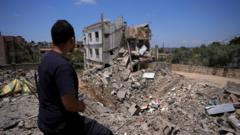
A man looks at the remains of a building destroyed by an Israeli strike in Kfar Sir, in Nabatieh district, southern Lebanon (16 June 2026)
Fragile quiet in Lebanon as US-Iran truce leaves unanswered questions
On Monday, hours after the announcement of a ceasefire agreement between the US and Iran, families that had been displaced because of the war began to return to communities in southern Lebanon, despite warnings from the authorities that it was not safe yet.
In a video widely shared online, some residents arrived by car in a village to find an Israeli armoured vehicle blocking a street.
Exhausted after more than three months of conflict, the people of Lebanon hoped the truce would also stop the fighting here between Israel and the Iranian-backed armed group Hezbollah.
A fragile quiet appears to be holding, despite Israel and Hezbollah carrying out attacks over the past day, but many remain doubtful that this could finally mean the end of the war.
A man called Abo Ali, who had been displaced from Jebchit in the Nabatieh area of southern Lebanon said his family "had returned, but with caution". Surrounded by heavily damaged buildings, he said: "All of this can be compensated for, and rebuilt."
Another man, Moustafa, was returning to the village of Aadshit, near Marjayoun, carrying only a suitcase. "For someone who's used to this area and has lived here, to come back and see this destruction is extremely hard," he said.
But he too remained unsure if the lull in the conflict would hold. "Israel can't be trusted," he added.
One million people remain displaced across Lebanon, most of them Shia Muslims
A displaced Lebanese woman smiles and gestures as she sits inside a car with her relatives during their journey home, on the highway near Sidon, southern Lebanon (16 June 2026)
The US-Iran agreement has not yet been made public, and it is unclear how it will apply to Lebanon. Both Iran and Pakistan, which acted as a mediator, said it included a ceasefire in the country - an Iranian demand that had become a key obstacle in the negotiations.
This round of conflict between Israel and Hezbollah started in March when Hezbollah launched rockets into Israel in retaliation for the killing of the Iranian supreme leader, Ayatollah Ali Khamenei, at the start of the US-Israel war against Iran. Israel responded with a devastating bombing campaign across Lebanon and another invasion of the country's south.
For Iran, including Lebanon in the truce was crucial in strengthening its image among Hezbollah supporters, who have been deeply affected by the conflict, and in reinforcing Tehran's influence domestically. Iran has financed, trained and armed Hezbollah since its creation in the 1980s.
Despite being weakened in the recent wars with Israel, the group, which is also a political party and a social movement running services including schools and hospitals, remains a significant force among Lebanon's Shia Muslim community.
Last month, I visited communities in the south of the country, Hezbollah's heartland, and saw that support for it endured amid Israel's constant attacks.
I visited communities in the south of the country
, Hezbollah's heartland, and saw that support for it endured amid Israel's constant attacks.
Israel had argued that the conflict against Hezbollah was separate from the one in Iran and that it should continue. But under pressure from the US, it may be left with no option other than to wind down, if not stop, its military campaign.
This war has been catastrophic for Lebanon. More than 3,800 people have been killed, including many women and children, according to the country's health ministry, whose figures do not distinguish combatants from civilians.
The Israeli military says it has killed more than 2,500 Hezbollah operatives; and Israeli authorities say 30 Israeli soldiers and four civilians have been killed during the war on both sides of the border.
One million people remain displaced across Lebanon, most of them Shia Muslims. Even with a ceasefire, many will not be able to return home.
Israel's government says Israeli forces will remain indefinitely in occupied parts of southern Lebanon
An Israeli military vehicle drives along a road on the Lebanese side of the border with Israel, as seen from northern Israel (15 June 2026)
And the truce still leaves unanswered questions.
Around 5% of Lebanon's territory is under Israeli occupation, and there is no indication of a withdrawal. Dozens of villages have been destroyed, and it is not clear when reconstruction will start, and who is going to pay for it.
Israeli authorities say the aim is to create what they describe as a security zone along the border, Hezbollah-free, to protect communities in northern Israel from the group's rockets and drones. After the US-Iran truce was announced, Israeli Defence Minister Israel Katz said Israel would stay indefinitely in land seized in Lebanon.
Finally, there is the issue of Hezbollah's arsenal. The Lebanese government also tried to separate the conflict in Lebanon from the one in Iran, to curb Iranian influence and, as a result, isolate Hezbollah even more.
Critics have long accused Hezbollah of dragging Lebanon into unnecessary wars with Israel, saying it defends the interests of its Iranian patron, and see this as an opportunity to disarm it.
For now, however, Hezbollah has rejected discussing the future of its weapons. The country's authorities say disarmament can only happen through diplomacy, but a negotiated solution remains a distant prospect.
The Lebanese have reason to be sceptical. Two other ceasefire announcements in the country failed to stop the war.
And the deal that ended the last conflict between Israel and Hezbollah in 2024 also did not bring peace. Israel continued to attack what it described as targets linked to Hezbollah almost every day.
This time, however, the group has already said it will not accept what Israel describes as freedom of action, and Iran's pressure may change Israel's calculation. Still, there is the fear that, once the world's attention moves away from the region, that this could be the reality of this country again.
Iranians walk past a billboard of the late Iranian supreme leaders, 15 June
Bowen: Iran deal ends Trump's war that revealed limit of US dominance
Netanyahu speaking in front of a a blue background and Israeli flag wearing a black suit and red tie
Iran deal presents political nightmare for Netanyahu
US President Donald Trump speaks during a proclamation signing in the Oval Office of the White House in Washington, DC, US, on Thursday, June 11, 2026.
US and Iran agree deal to end war as Trump says Strait of Hormuz to reopen
Both sides declare "the immediate and permanent termination of military operations on all fronts, including in Lebanon", Pakistan says.
Israel says it targeted the Iran-backed armed group Hezbollah, as Tehran warns this could derail a US-Iran deal to end the fighting.
The strikes come as Iran's foreign minister says a deal to end fighting with the US is close.
For many Iranians, the question is not whether the deal means victory, but whether it lowers prices and reduces fear of another war.
The move comes six months after Israel became the first country to recognise the breakaway East African state.
The conflict in the Middle East has increased pressure on the cost of petrol, household energy bills and even food.
The US vice-president says the agreement is "about a page and a half" and "very general", meaning many details will be worked out later.
Donald Trump's ceasefire agreement with Iran leaves the Israeli PM trapped in a new political and security dilemma.