
World
Cuba tourism collapses as US pressure campaign bites
June 16, 2026 International Source: BBC World
The number of foreign visitors is down by 58% compared to last year, Cuban officials say, amid sanctions and an effective oil blockade.
Cuba tourism collapses as US pressure campaign bites
Copyright current_year BBC. All rights reserved. The BBC is not responsible for the content of external sites. Read about our approach to external linking.
Copyright current_year BBC. All rights reserved. The BBC is not responsible for the content of external sites.
Read about our approach to external linking.
Fuel shortages means even fewer cars are on the road in Havana then before sanctions were tightened
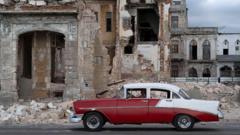
An old car drives past debris from a demolished house occupying part of the seaside promenade in the Centro Habana neighbourhood in Havana on 9 June , 2026
The number of foreign travellers visiting Cuba has plummeted since the beginning of the year amid tightened US sanctions, figures released by Cuba's national statistics agency suggest.
Fewer than 360,000 people visited the Communist-run island in the first five months of 2026, a decrease of 58.4% compared to the same period last year, according to Onei.
The Trump administration has targeted the tourism sector, a key source of income for Cuba's beleaguered government, as part of its pressure campaign against the island's leadership.
As a result, a number of foreign airlines and hotel operators have stopped operating in Cuba, further driving down visitor numbers.
US President Donald Trump has his mouth open in a close up shot. His eyebrows are raised and he is wearing a blue suit jacket.
Trump is putting pressure on Cuba - why and to what end?
Earlier this month, Air Canada announced it was suspending its flights to Cuba indefinitely, citing the "ongoing political and economic uncertainty" as its reason.
The carrier had already stopped flying to the island in February because of a shortage of aviation fuel on the Caribbean island.
The carrier had already stopped flying to the island in February
because of a shortage of aviation fuel on the Caribbean island.
The move comes as a particular blow as Onei figures suggest visitors from Canada constituted by far the largest contingent of foreign tourists to Cuba this year.
Spanish hotel chains Meliá and Iberostar also halted their operations at a significant number of hotels ahead of a 5 June deadline set by the US government for companies to cease doing business with Cuban conglomerate Gaesa.
US Secretary of State Marco Rubio has accused Gaesa, which is controlled by Cuba's armed forces, of acting as a "state within a state".
In a speech delivered in Spanish and directly addressing the Cuban people, Rubio said Gaesa "hoards the profits from its businesses for the benefit of a small elite" as well as "repressing anyone who dares to complain".
US sanctions and an effective oil blockade have exacerbated already existing shortages of fuel, medicines and food in Cuba.
Cubadebate, a state-run news site, reported on Monday that the survival rate for children with cancer had fallen from 85% to 65% since January, when US President Donald Trump threatened to impose sanctions on any country or company providing Cuba with oil.
The lack of fuel has paralysed large sectors of the economy, including rubbish collection, leading to piles of garbage piling up in city streets.
Frequent, lengthy and wide-spread power cuts have triggered rare protests on the island, where public dissent is often punished with long prison sentences.
Two women stand in a street in Havana in which piles of rubbish have accumulated. There are empty cardboard boxes, bin bags and general refuse in a mountain at one side of the street. One of the women is carrying plastic buckets and brooms. Another stands in the middle of the street pointing at something.
AFP reported on Sunday that among the many items becoming scarce were communion wafers.
Several Catholic priests told the news agency they had been asked to ration the wafers, which are offered to the faithful as part of Mass.
The communion wafers are made in a monastery in the capital, Havana, where nuns are struggling to keep up production of the unleavened bread as their electricity supply is often restricted to two hours a day, it reported.
A woman wearing a yellow, short-sleeve top and with glasses on a string around her neck sits in front of a kitchen
Cubans grapple with fuel shortages and blackouts as US steps up pressure
US Secretary of State Marco Rubio speaks to the press in front of a plane
Rubio says Cuba is threat to US as Havana accuses him of 'lies'
Man holding an "intervene now" sign in Miami, Florida.
Will US invade? Three ways Cuba crisis could play out now
Will Grant spoke to a 70-year-old widow who says the inability to use her building's elevator during a power outage trapped her and her husband when he needed medical care.
BBC's Will Grant visited Barrio Toledo, where at least 700 containers are being repurposed into two-bedroom homes with kitchens, bathrooms and patios.
BBC's Will Grant reports from a pro-government demonstration held after the US indictment of the former president.
Tourism is a key part of the Northern Ireland economy, but will visitors now be reluctant to come?
Nobody was seriously hurt as a result of the accident in the Spanish town, local authorities say.
St Ives MP Andrew George wants to give local councils more control over housing.
"It is about jobs, transport, culture and showcasing our region," says mayor Paul Bristow.
Councillors in the region drop the process entirely and will consult no further on the proposals.