World
Weapons, money and ships: How is this Iran deal different from others?
June 18, 2026 International Source: BBC World
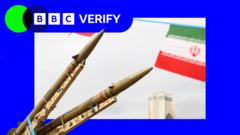
BBC Verify examines how the new deal between the US and Iran affects three key areas.
Weapons, money and ships: How is this Iran deal different from others?
Copyright current_year BBC. All rights reserved. The BBC is not responsible for the content of external sites. Read about our approach to external linking.
Copyright current_year BBC. All rights reserved. The BBC is not responsible for the content of external sites.
Read about our approach to external linking.
Bunting of Iranian flags next to missiles on display, with Azadi Tower in the background, during the 47th anniversary of the Islamic Revolution in Tehran, Iran February 11, 2026.
Policy and analysis correspondent, BBC Verify
President Donald Trump has formally signed a deal with Iran to end the conflict that began on 28 February when the US and Israel launched air strikes against Tehran and across the country.
The terms of the 14-point Memorandum of Understanding (MoU) between the US and Iran have been criticised over what is included and what is left out.
There have also been questions about how the agreement - which lays the groundwork for talks on Iran's nuclear weapons programme - will also affect economic sanctions and access to the Strait of Hormuz.
Comparisons have inevitably been made between this deal and the 2015 Obama-era nuclear accord known as the Joint Comprehensive Plan of Action (JCPOA) which Trump scrapped in his first term.
To make sense of the current deal, BBC Verify has looked through key details of the documents to compare it with the situation during three distinct periods:
1. When the JCPOA was in force between 2016 and 2018
2. Before the war began on 28 February 2026
Iran's President Masoud Pezeshkian visits Iran's nuclear achievements exhibition in Tehran, Iran, on 9 April 2025
The whole point of the JCPOA - which included the UK, France, the EU, China and Russia - was to impose specific limitations on Iran's nuclear programme.
That highly technical document restricted Iran's stockpile of nuclear material to 300kg and said it could not enrich its uranium above 3.67% for 15 years. This level of enrichment is not high enough to be used in nuclear warheads but can be used in reactors to generate electricity.
The JCPOA also allowed the International Atomic Energy Agency (IAEA) access to Iran's nuclear programme to ensure it was complying with the agreement.
The IAEA said Iran had been complying until Trump withdrew the US from the JCPOA in 2018, calling it "decaying and rotten".
Following the collapse of that deal Iran stepped up its nuclear programme.
At the start of the war on 28 February 2026, Iran possessed approximately 440kg of uranium enriched to 60%, according to US officials. The material can be fairly quickly enriched to the 90% threshold needed for weapons-grade uranium.
A US navy airman gives an F-35 fighter a signal to take off. He is wearing a yellow jacket and a helmet and is pointing towards the runway. The jet is armed with missiles and is painted grey. The image is imposed over a satellite photo of an airbase in Iran where damaged jets are highlighted.
More than 50 Iranian military bases damaged in US strikes since start of war, satellite images show
A promo image shows a damaged E-3 Sentry plane emblazoned with the words US AIR FORCE. The tail of the plane has been severed and the aircraft it surrouded by debris. The image is imposed over a satellite image showing destroyed aircraft hangars at a US base.
Iran attacks damage 20 US military sites since start of war, satellite images show
While the new MoU text, as read out by the White House to the BBC and other media organisations, states that Iran "reaffirms that it shall not procure or develop nuclear weapons" there is little detail about the issue in the document.
There is similar language in the JCPOA, which stated "Iran reaffirms that under no circumstances will Iran ever seek, develop or acquire any nuclear weapons".
The new MoU also says the two parties "agreed to discuss the issue of enrichment" and to "resolve the disposition of stockpiled enriched material pursuant to a mechanism that will be mutually agreed upon" - again, suggesting this will be included in forthcoming negotiations.
In recent weeks Trump has said that Iran's remaining nuclear material will be removed from the country.
US officials briefed that the deal "sets a minimum standard where… the enriched stockpile will be destroyed". But the MoU actually makes no mention of this happening.
It is important to bear in mind that the JCPOA was a final, detailed, agreement negotiated over two years while the MoU is framework for 60 days of talks about a nuclear agreement so the two are not directly comparable.
As well as tackling Iran's nuclear weapons programme, Trump said on 2 March, shortly after the start of the conflict, the US was "destroying Iran's missile capabilities… and their capacity to produce brand new ones".
But the MoU text makes no mention of Iran's ballistic missiles.
And Trump said on 17 June that it would be "unfair" for Iran not to have these missiles given other countries in the region have them.
In 2018, when he scrapped the JCPOA, Trump complained: "Not only does the deal fail to halt Iran's nuclear ambitions, but it also fails to address the regime's development of ballistic missiles that could deliver nuclear warheads."
The 2015 JCPOA did not involve the US paying Iran new money but provided sanctions relief and restored Iran's access to some of its own assets, including those of its central bank, that had been frozen or seized abroad.
An official at the US Treasury estimated in 2015 that unfrozen Iranian central bank assets were worth between $100bn and $125bn - but did add that the total assets which Tehran could access as a result of the sanctions relief would only be around $50bn.
Economic sanctions were re-imposed on Iran after Trump scrapped the JCPOA and were progressively stepped up in the following years.
Iranians protesting on the streets over the collapsing value of its currency and cost of living concerns in January 2026
Before the war began on 28 February sanctions by the US and other countries had created extreme economic difficulties in Iran.
The state of the economy is considered to be one of the causes of country-wide protests across Iran which were violently repressed by the government in January.
The US also placed sanctions on Iranian oil which made it difficult for Tehran to sell its crude overseas - although it was able to partially get round them by using a "shadow fleet" of tankers.
The new MoU says the US will "terminate all types of sanctions" against Iran in an agreed-upon schedule.
But significantly it allows for the issuing of waivers immediately after the signing of the deal allowing "the export of Iranian crude oil, petroleum products and derivatives and all associated services including banking, transactions, insurances, transportation".
There are no conditions upon Iran for this and it apparently leaves it in a much better position than at the start of the war.
The memorandum also says the US along with "regional partners" will develop a plan, funded with "at least $300bn", for the "reconstruction and development" of Iran.
Before the recent conflict began ships carrying oil, natural gas and fertiliser had been able to pass freely through the Strait of Hormuz for many years.
In fact, the narrow seaway was not mentioned at all in the JCPOA.
Ship-tracking data published by the International Monetary Fund (IMF) shows a daily average of 94 merchant ships transited the strait in 2025.
Two ships seen in the Strait of Hormuz off Iran's Bandar Abbas
Since the conflict began on 28 February, the daily average number of transits collapsed to just six, according to this data, though a number have been crossing with their location transmitters turned off so the true figure will likely be somewhat higher.
This collapse was due to a combination of Iranian attacks on commercial shipping that began shortly after the war started and a US blockade of Iranian ports.
The MoU states that the US will "fully end" its naval blockade of Iran "within 30 days".
It also states that Iran will "make arrangements using its best efforts for the safe passage of commercial vessels with no charge" through the Strait of Hormuz but adds that this will be "for 60 days only".
Thereafter it says Iran will "conduct dialogue" with Oman "to define the future administration and maritime services in the Strait of Hormuz".
On 21 May Iran announced that it had unilaterally established a Persian Gulf Strait Authority to regulate shipping through the waterway.
And Iran's foreign ministry is reported to have said this week that, although there will not be "transit tolls" for shipping, there will be "fees" for using the strait which will be "charged in exchange for the services that are provided".
The deal, and indeed the White House's commentary around it, makes no mention of taking action to stop Iran from charging these fees in the future - which would be a boost to Iran's economic power and influence in the region relative to the situation before the war.
The 14-point Memorandum of Understanding was signed at a post-G7 dinner in France.
Trump has insisted the deal ensures that Iran will never buy, develop or produce a nuclear weapon. But text of the agreement falls short of that.
A peace deal remains a "moment of fear" for the family of Lindsay and Craig Foreman, they say.