
World
Zimbabwe MPs pass bill to extend president's time in power
June 19, 2026 International Source: BBC World
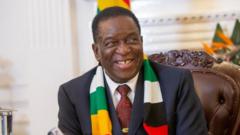
The proposal would extend Emmerson Mnangagwa's term by two years and scrap direct presidential elections.
Zimbabwe MPs pass bill extending President Emmerson Mnangagwa time in power
Copyright current_year BBC. All rights reserved. The BBC is not responsible for the content of external sites. Read about our approach to external linking.
Copyright current_year BBC. All rights reserved. The BBC is not responsible for the content of external sites.
Read about our approach to external linking.
President Emmerson Mnangagwa was due to step down in 2028 when his second term expires
President Emmerson Mnangagwa sits smiling wearing a dark suit, red patterned tie and a scarf in green, white, red and black colours of the Zimbabwean flag.
Zimbabwe MPs pass bill to extend president's time in power
Zimbabwe's lower house of parliament has passed a bill to extend presidential terms from five to seven years, which would allow President Emmerson Mnangagwa to remain in power until 2030.
More than 200 lawmakers voted in favour of the draft legislation on Thursday, surpassing the vote threshold required for a two-thirds majority to amend the constitution.
The bill also scraps direct presidential elections, with future presidents chosen by parliament.
Mnangagwa, 83, took power in 2017 after ousting long-time ruler Robert Mugabe with the backing of the military - and went on to win disputed elections in 2018 and 2023.
The bill now heads to the senate, where it is also expected to secure approval, before being enacted by the president.
A head and shoulders image of Emmerson Mnangagwa wearing a Zimbabwe scarf around his next and a pair of glasses. He is looking to the left of the picture.
Plan to scrap presidential elections puts Zimbabweans at loggerheads
This is the culmination of a campaign by the ruling Zanu-PF party - in power since independence in 1980 - to amend the constitution and extend presidential terms, a plan that received cabinet backing in February.
The president had previously described himself as a constitutionalist and pledged to respect term limits.
During Thursday's vote, Speaker of Parliament Jacob Mudenda announced that 216 lawmakers had backed the legislation, surpassing the 187 votes required to amend the constitution. Forty-two lawmakers voted against it.
The amendment contains several provisions:
Presidential elections - held since 1990 - are scrapped
Parliamentary and presidential terms extended from five to seven years
Parliamentary elections scheduled for 2028 delayed to 2030
President Mnangagwa, whose second and final term is due to end in 2028, remains in office until 2030.
Opposition parties, civil society groups and constitutional lawyers have argued that such fundamental changes should be put to a national referendum rather than being approved solely through parliament.
Initially hailed by supporters as a reformer who would restore economic growth and democratic governance, Mnangagwa's presidency has instead been marked by economic challenges, disputed elections and growing concerns over democratic backsliding.
The latest constitutional changes have intensified debate over Zimbabwe's political future, with opponents warning that the amendments could weaken democratic accountability, while supporters maintain they are necessary to ensure continuity and stability.
A new constitution adopted in 2013 restricted a president to serving a maximum of two terms, adding that any move to extend term limits would need to be endorsed by voters in a referendum and that a sitting president cannot benefit from any extension unless voters give their approval in a second referendum.
However, on Wednesday, the country's Constitutional Court dismissed a legal challenge seeking to block the bill.
Two men and one woman in green hats and one holding a Zimbabwean flag attend a political campaign meeting held by President Emmerson Mnangagwa in July 2018 for members of the white farming and business community.
Will Trump help or hinder Zimbabwe's white farmers in their compensation battle?
Grace and Bellarmine Mugabe are standing together, smiling and wearing red neck scarves as they jointly cut a cake in 2011
The Mugabe family after losing power - arrests, accusations and arguments
A minibus taxi in Harare with its back painted with a big portrait of Sir Wicknell in a green long-sleeve top with polo players on its front.
How a self-styled knight giving away cars and wads of cash got people talking
A woman looking at her mobile phone and the graphic BBC News Africa
Go to BBCAfrica.com for more news from the African continent.
for more news from the African continent.
Follow us on Twitter @BBCAfrica, on Facebook at BBC Africa or on Instagram at bbcafrica
The US says South Africa is not doing enough to protect the white-minority Afrikaner community.
Diezani Alison-Madueke was cleared of taking bribes from wealthy oil executives after six-month trial.
Health facilities have come under attack during the current outbreak as a result of misinformation and fear.
Malawi is among several African nations transporting their citizens out of the country following reports of violence against migrants.
Tendai Chatama and Nyamwererei Chatikobo will be sharing dishes as part of Africa Week.
The 28-year-old was arrested in February after a man had been shot at his home in Johannesburg.
For centuries the prized sculptures, central to national identity, have been kept outside Zimbabwe's borders.
Bellarmine Mugabe was arrested in February following the shooting of a 23-year-old man at his home in Johannesburg.