
World
African and Caribbean nations call for formal apology for transatlantic slavery
June 20, 2026 International Source: BBC World
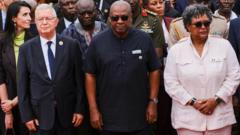
The leaders have asked for apologies from the countries that benefited from the slave trade, as well as debt relief and financial compensation.
African and Caribbean nations call for formal apology for transatlantic slavery
Copyright current_year BBC. All rights reserved. The BBC is not responsible for the content of external sites. Read about our approach to external linking.
Copyright current_year BBC. All rights reserved. The BBC is not responsible for the content of external sites.
Read about our approach to external linking.
Ghana's President John Dramani Mahama, Barbados' Prime Minister Mia Amor Mottley and other dignitaries attend a wreath-laying event at the Christiansborg Castle, a former slave post, during a high-level consultative conference on the next steps to the landmark United Nations resolution on the trafficking of enslaved Africans, in Accra, Ghana, June 19, 2026
Ghana's President John Dramani Mahama, Barbados' Prime Minister Mia Amor Mottley and other dignitaries stand looking solemn.
African and Caribbean countries have called for a formal apology and reparations from countries that benefited from the transatlantic slave trade.
The demands come at the end of a three day conference in Ghana which looked to advance the push for reparatory justice.
It follows a landmark UN resolution earlier in March which recognised transatlantic slavery as the "gravest crime against humanity", urging UN member states to contribute to a reparations fund.
Around 12-15 million African men, women and children were captured and trafficked to the Americas to work as slaves from the 15-19th century.
A 19-point reparations plan has been endorsed as part of the "Next Steps" conference in the Ghanaian capital of Accra.
It calls for comprehensive debt relief, the restitution of looted cultural property, and the establishment of a global reparations fund, though no specific amount was stated. It also addresses the disproportionate impact of slavery on African women and girls.
The conference leaders also called on countries formerly involved in the slave trade to offer their "full, formal and unconditional apologies".
Ghana's President John Dramani Mahama told delegates: "History does not ask us to inherit guilt, but it asks us to inherit responsibility".
French President Emmanuel Macron also gave a virtual note at the conference, where he recognised that enslaved people were "dehumanised and treated as goods".
However, he cautioned against reducing reparations for slavery to financial compensation alone, saying they should not be seen as a "cheque written to bring the story to a close".
The UN General Assembly vote took place in March, with 123 votes in favour, and three votes - the United States, Israel and Argentina - against declaring the transatlantic slave trade a crime against humanity.
52 countries, including the United Kingdom and European Union member states abstained.
Unlike UN Security Council resolutions, those from the General Assembly are not legally binding.
The UK has long rejected calls to pay reparations, saying today's institutions cannot be held responsible for past wrongs.
"No single set of atrocities should be regarded as more or less significant than another," UK ambassador to the UN James Kariuki had then said.
The US ambassador to the UN echoed this, saying his country did not "recognise a legal right to reparations for historical wrongs that were not illegal under international law at the time they occurred".
He added that the UN resolution was unclear as to "whom the recipients of 'reparatory justice' would be".
No country has ever paid reparations to the descendants of enslaved Africans or affected African, Caribbean and Latin American nations.
Most of the reparations paid by governments came in the form of compensation to slave owners in the 19th Century, rather than to those who had been enslaved.
That includes the UK - in the 1830s, following the abolition of slavery, the country paid owners the equivalent of more than $21bn (£16bn) in today's money.
A black and white sketch of three slaves being restrained
UN votes to recognise enslavement of Africans as 'gravest crime against humanity'
Close up of statue showing liberation from slavery on Goree Island in Senegal. It is a man from shoulders up, with his arms raised, holding a broken chain in his hands which is still attached to his wrists. The statue also includes the figure of a woman standing in front of the man - all that is visible of her is the back of her head, and she has a head wrap on.
'The gravest crime against humanity': What does the UN vote on slavery mean?
The landmark resolution calls for an apology and contributions to a reparations fund, without specifying an amount.
Workshops are being held to held people find out more about their own ancestry.
The cathedral says the artwork has been designed to be viewed "in dialogue" with the Colston window.
Sibling rivals are lining up for different teams at the World Cup, with seven pairs of brothers in total at this tournament.
More than eight million South Africans are living with HIV – the highest number of any country in the world.
Diezani Alison-Madueke was cleared of taking bribes from wealthy oil executives after six-month trial.
Your chance to rank 10 of the most colourful and iconic kits African teams have worn at the World Cup.
Health facilities have come under attack during the current outbreak as a result of misinformation and fear.