
World
Is Germany looking again at coal-powered electricity?
June 22, 2026 International Source: BBC World
It had planned to abandon the fuel, but the higher cost of natural gas may make it think again.
Is Germany looking again at coal-powered electricity?
Copyright current_year BBC. All rights reserved. The BBC is not responsible for the content of external sites. Read about our approach to external linking.
Copyright current_year BBC. All rights reserved. The BBC is not responsible for the content of external sites.
Read about our approach to external linking.
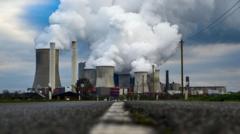
Germany currently gets 20% of its electricity from coal-powered stations
Vapour billowing from the cooling towers of the Niederaussem power station in Germany, which burns cheap, lignite coal
They have a word for it in German – kohleausstieg, which means "coal phase out".
Germany is the biggest user of coal for power generation in Europe, and the fourth largest in the world after China, India and the US. But it has pledged to stop using it altogether by 2038.
For lignite, the low-quality soft coal that is the most polluting, Germany has even brought the phase out forward to 2030.
Currently some 20% of German power generation comes from coal, but it wishes to end this as it focuses on growing wind and solar.
In fact, Germany already gets more than half of its electricity from renewables, 59% last year.
In fact, Germany already gets more than half of its electricity from renewables,
As back-up to wind and solar, especially for the winter months, it wants to replace coal with more natural gas power stations. These generally release half as much carbon dioxide as coal, and gas currently accounts for 13% of German electricity generation.
However, the recent jump in global gas prices following the US-Israel conflict with Iran, has encouraged a number of countries to reconsider coal as an energy source.
Japan has loosened rules to allow for the increased use of coal-fired power plants, Italy is delaying the closure of its remaining stations until 2038, and India has postponed maintenance shutdowns.
to allow for the increased use of coal-fired power plants, Italy is
of its remaining stations until 2038, and India has
But what about Germany? Back in March, Chancellor Friedrich Merz said: "We must supply this country with electricity. I am not prepared to jeopardise the core of our industry simply because we have adopted phase-out plans that have become unrealistic."
Was this the start of a phase-out of the phase-out? Is Germany going to keep coal power after all?
The problem for the German government regarding what the country burns to make electricity is a two-fold one of supply and price. Germany has an abundance of readily available, cheap lignite. It has the largest reserves in Europe and the third biggest globally. It is entirely self-sufficient in the fuel.
By contrast, it has to import 95% of its natural gas supplies. So when the global cost of gas shoots up, switching back to the much cheaper lignite is financially very appealing. And Germany doesn't have to worry about supply shortages.
Meanwhile, nuclear is not an option, as Germany closed the last of its nuclear power stations in 2023.
Germany has an abundance of cheap lignite coal
Mining machines at an open-cast lignite coal mine in eastern Germany
Perhaps unsurprisingly, German energy firm LEAG, which is the country's second biggest miner of lignite, is upbeat at the suggestion that coal-powered energy power could get a reprieve.
"We very much welcome the fact that the German federal government is placing not only medium, but also long-term, security of supply at the heart of its energy policy considerations," it said in a statement.
It also highlighted that it increased supplies of lignite to compensate for the halting of Russian gas imports after Russia's 2022 invasion of Ukraine. "We already demonstrated our ability to quickly draw on reserves to return to the market when the situation demands it."
By contrast, Hauke Hermann, a senior researcher with the Öko environmental research institute insists that more coal is not the answer. Instead, he wants to see a further increase in the use of renewables.
For some in German industry, they just want a decision regarding gas or coal. "Our industry needs reliable energy," says Wolfgang Große Entrup, director general of the German Chemical Industry Association (VCI).
"Renewable energy alone cannot yet guarantee this… Companies will only invest billions if they can trust that energy will remain reliably available at competitive prices in the future."
While practically no-one outside of the far-right AfD party is calling to scrap the coal phase-out altogether, some loosening of the phase-out is another matter.
One possible compromise being put forward concerns six coal power stations that use imported hard coal, which is less polluting than the domestic German lignite. These are currently only used as back-up, to top up the national grid as and when required, such as during a cold winter.
The owner of some of these power plants, Steag Iqony Group, says they should be allowed to operate all the time.
"If they were temporarily allowed to resume regular production, they could deliver electricity to several million homes," says a spokesman for the company. "We think these plants should be used in order to strengthen security and affordability of supply."
A parliamentary committee set up in March is studying this possibility.
Germany gets most of its electricity from renewables, but wants fossil fuel power stations as a backup
A German wind farm, with pylons spread out across flat fields
The difficulty for the German government is that it is a grand coalition comprising the centre-right CDU/CSU parties and the left-wing SPD. The former are more favourable to extending the use of coal, while the latter is against.
The SPD's energy spokeswoman Nina Scheer warns that relaxing the rules for coal would be "counterproductive for the energy transition and mean new fossil lock-in effects".
By contrast, the deputy leader of the CDU, and Minister-President of the German region of Saxony, Michael Kretschmer, says: "Germany, as a major industrial nation, must do everything in its power to ensure that energy remains affordable."
He adds: "The energy transition must be completely recalculated. It should not be a matter of cost, but rather a matter of realistically considering security of supply and affordability."
The government must decide this year whether the 2030 deadline for lignite phase-out must be respected, or whether some capacity may be maintained for a limited period as a strategic reserve.
And in August, the government will publish a statutory review of the coal phase-out which will include the impact it is having on energy supply, security and prices. The original purpose was to see if the Kohleausstieg could be accelerated. It is now quite possible that it will be used to slow it down.
British tourists in the Spanish city of Benidorm
Spain's visitor numbers hit new highs as tourists avoid Middle East
The hand of a diamond miner in Sierra Leone has he sieves gravel and smaller stones in the hope of finding the precious gems
'By the grace of God': Miners dig on as lab-grown diamonds change market
The film's opening is a return to form for Disney and Pixar after facing notable challenges in recent years.
An AI company is sending free cleaners door-to-door in a bid to train the robots it hopes one day will replace them.
With fuel and gas prices having fallen in recent days, we look at how the end of hostilities might affect you - in five charts.
It was not long ago that his manager Julian Nagelsmann called him out openly - but Deniz Undav is proving himself a key player for Germany at the World Cup.
Deniz Undav rescues Germany with his second-half double helping them to come from behind to defeat Ivory Coast and book their place in the knockout stages of the World Cup.