
World
Thousands of 'lost Canadians' have applied for dual citizenship - is Canada ready?
May 2, 2026 International Source: BBC World
Changes to Canadian citizenship rules have led to thousands of new applications - many coming from the US.
These 'lost Canadians' are hoping to get dual citizenship by descent
Copyright current_year BBC. All rights reserved. The BBC is not responsible for the content of external sites. Read about our approach to external linking.
Copyright current_year BBC. All rights reserved. The BBC is not responsible for the content of external sites.
Read about our approach to external linking.
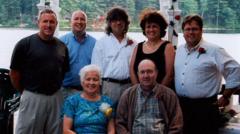
Joe Boucher (far right) says he and his siblings (back row) learned to be proud of their French-Canadian heritage from their parents (front)
Standing left to right: are the Boucher siblings - Daniel Boucher, William Boucher, Robert Boucher Jr, Therese Boucher, Joseph Bouche. The elder Robert Boucher and his wife sit in front. Many wear boutonnieres.
Thousands of 'lost Canadians' have applied for dual citizenship - is Canada ready?
As the youngest of five children, Joe Boucher learned a lot from his older brothers and sister - how to ride a bike, how to navigate the miles of forest behind their house and how to skate and play hockey. But one thing he didn't really pick up from them is how to speak French.
Although both of Boucher's parents were of French-Canadian descent and spoke French with each other, it was once illegal to teach French in school in the US state of Maine, where the Bouchers lived. And so his siblings, amongst themselves, defaulted to English.
"Shame was heaped upon French speakers as being second-class citizens," he recalls.
More than a million French-Canadians moved from Canada to the New England region of the US in the 19th and 20th Century, mostly to seek jobs in mills or on farms. At the time, the law made it difficult for Canadians to pass on citizenship to their children born in the US. And so, generations of so-called "lost Canadians" were born.
The hand of a car passenger holding up a dark blue Canadian passport
'Lost Canadians' citizenship bill now in place
An employee works in the Northern Graphite mine plant in Lac-des-Îles, Quebec
Canada's Carney launches a sovereign wealth fund. What is it?
A new law, which came into force in December, aims to correct that historical inequity, by allowing not just the children of Canadians to claim citizenship, but anyone who can prove an ancestral tie.
Between 15 December 2025 and 31 January 2026, Canadian immigration officials received 12,430 applications, of which 6,280 applications were processed, and 1,480 were granted.
Coming into force at the tail end of President Donald Trump's first year of his second term, the law has struck some as fortuitously timed.
Coming into force at the tail end of President Donald Trump's first year of his second term,
the law has struck some as fortuitously timed.
"We sort of feel the ground shifting under our feet a little bit these days," Boucher told the BBC.
"It's nice to know that the connectivity to the home country, as it were, is there."
Boucher is now in the process of applying for "proof" of Citizenship - under the new law, descendants are automatically considered Canadian, so the application is not to become Canadian, but to prove one's Canadian-ness. The application only costs C$75 ($55; £40), but the cost of genealogists, records fees and lawyers can push the total cost into the thousands.
To prove their ties to Canada - however far back they may go - many have had to look up historic records like census reports, baptismal records and birth certificates.
That's kept Montreal genealogist Ryan Légère so busy he's considering hiring an employee.
"What was kind of like a side business has turned into full time," he told the BBC.
A statue of Joe Boucher's distant relative, Pierre Boucher, who was governor of the French settlement in Quebec City in the 17th Century
A bronze statue of a 17th Century aristocratic soldier holding a sword in front of a grey stone building
Légère says he's worried about the unintended consequences of the law, which was passed after an Ontario court found that limiting citizenship rights to only the first-generation was unconstitutional.
"Many institutions appear to be overwhelmed, understaffed, and not fully prepared for the volume of requests received over the past few months," he says.
He also notes the challenges that many applicants run into in their search for their Canadian ancestors. Birth certificates were not standardised in Quebec until the 1990s - before that, many births were recorded by the parish in baptismal certificates. Many of these records are not only just in French, but use old-fashioned and hard-to-read script. Family surnames can also change from one generation to the next, as many anglicised their name when they moved south of the border. A Desjardins might become Gardner; a Bonenfant, Goodchild.
He also notes the challenges that many applicants run into in their search for their Canadian ancestors. Birth certificates were not standardised in Quebec
until the 1990s - before that, many births were recorded by the parish in baptismal certificates. Many of these records are not only just in French, but use old-fashioned and hard-to-read script. Family surnames can also change from one generation to the next, as many anglicised their name when they moved south of the border. A Desjardins might become Gardner; a Bonenfant, Goodchild.
A spokesperson for Immigration, Refugees and Citizenship Canada told the BBC that each application was "reviewed on a case-by-case basis to determine eligibility".
Applicants must provide official documents - online genealogy sites can't be used as sole proof, the spokesperson cautioned.
The biggest challenge lies with how Canada will respond to all these applicants, Légère says.
The new law does not give a cut-off for how far back a qualifying ancestor could be - but going forward, the Canadian parents must have lived in Canada for more than 1,095 days in order to pass on citizenship to their children.
Applicants must trace their ancestry back to a parental relative - a parent, grandparent, great-grandparent, and so on - who became a Canadian citizen on or after 1 January 1947, which is when the first Canadian Citizenship Act was introduced.
Boucher says he and his wife vacation often in Quebec City and dream of someday living there - but he's not ready to move yet
Joe Boucher and his wife stand in a busy brick-lined street, smiling and wearing zip-up sweatshirts
Even with those limits, it's possible that millions of Americans from all over the country could qualify.
But would these new Canadians pack up their bags and move north?
For Tim Cyr, another Mainer with French-Canadian ancestry, he thinks not. Like Boucher, he cites Trump's presidency as a reason to seek dual citizenship.
"We're facing something I never thought we'd face in a million years," he says. "It's not a great time to have an American passport."
But while he likes to visit Canada, he doesn't anticipate moving anytime soon.
"I'm mostly interested in dual citizenship, I hope we can get through what we are in."
But Boucher is clear that his interest in Canada is not just about finding an escape hatch.
"I keep coming back to the idea of identity," he says.
People "hear my last name and know that I am of French descent and they make a false connection to the European tropes of a Parisian lifestyle".
"I have zero connection to any of that. My ancestors arrived in Canada 400 years ago and spent generations creating communities and cultivating the land in Quebec and Acadie. This is the family I know and this is in large part who I am."
Growing up, his father was fiercely proud of their French-sounding name, and as well as the history of the Acadian people, their culture and music. The Acadians were French settlers in the eastern part of Canada. When Britain took control of the region in the mid-18th Century, about 10,000 Acadians were expelled to the United States, settling in New England but also places like Louisiana.
Now a musician, Boucher celebrates his French-Canadian roots, even turning the Henry Wadsworth Longfellow poem about the Acadian expulsion, Evangeline, into a song.
If given the chance, would he move? He hesitates.
"My life is very much here, we've got three children and extended family and my wife grew up in New York City," he says. "But there could be a time in the future… I've fantasised about living there for many years."
Thousands of demonstrators marched across the country to demand “dignity, justice and freedom” for immigrants and workers.
The court decision curbs access to the drug used in medication abortions, which is currently the most common method for the procedure in the US.
Court papers do not explicitly accuse the suspect of shooting the officer, even as officials say it was not "friendly fire".
Churchill, Manitoba, best known as the world's polar bear capital, has ambitions of making its deep-water port a year-round trade route.
The lawsuits, filed in California, accuse OpenAI and Sam Altman of negligence and abetting a mass shooting by failing to flag the suspect's ChatGPT activity.
The government says Canada's debt is 14% lower than projected earlier, with savings being used to justify billions in new spending.
Global acclaim and domestic political gains have defined Mark Carney's first year as Canada's PM. He now faces pressure to deliver on his bold promises.
The fund - which Canadians can invest in directly - will help pay for major infrastructure projects in the country, the prime minister says.