
World
'I had to stick to the plan': Officer describes retrieving crocodile with human remains inside
May 5, 2026 International Source: BBC World
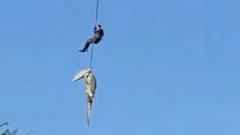
DNA tests are underway to confirm whether remains found inside the crocodile match that of a missing man.
Police officer tells of operation to retrieve human remains from crocodile
South African Police recover crocodile by helicopter in search for human remains
Copyright current_year BBC. All rights reserved. The BBC is not responsible for the content of external sites. Read about our approach to external linking.
Copyright current_year BBC. All rights reserved. The BBC is not responsible for the content of external sites.
Read about our approach to external linking.
A grainy screen grab showing a rope with a crocodile on the end with a man holding on higher up
Captain Johan Potgieter sits in a helicopter, wearing his police uniform. He wears a pair of headphones with a microphone attached.
A police officer has recalled the moment he was lowered from a helicopter into a crocodile-infested river in South Africa as part of an effort to recover human remains.
Captain Johan Potgieter was tasked with capturing a crocodile suspected of eating a businessman who had been swept away by floodwater.
"The crocodile itself was lying on an island... there really was no other way to get to it except from the air," he told the BBC.
Since the operation, remains have been found inside the 4.5m (15ft) and 500kg (1,100lb) crocodile. DNA tests are underway to confirm their identity.
The man's car had become stranded attempting to cross a low bridge in the flooded Komati River last week. By the time the police got to the scene, it was empty, leading them to suspect he had been swept away by the water.
Drones and helicopters were used to in the search mission which led police to a small island where a number of crocodiles lay in the sun, one of which they believed had eaten the man.
The suspect crocodile was shot by Potgieter's colleagues before he was called.
"It turned onto its back and they thought that it was dead. But by the time we went back, it was back onto its right side and it had swum a bit upstream," he explained.
The presence of other crocodiles, hippos and rocks in the river, meant it was too dangerous to use a boat or canoe to recover the body, Potgieter told the BBC.
"There were other crocodiles next to that one that were probably there because of the blood in the water. But luckily because of the noise of the helicopter and the downdraft blowing around, they moved away and didn't bother me," the veteran officer said.
Once Potgieter agreed to do the recovery operation, there was no turning back.
"When I was hanging there, there was no way for me to communicate with the pilot. So irrespective of whether I changed my mind and decided not to do it, there was no way that that was going to happen," he added.
"I had to stick to the plan and do as we had planned... otherwise things would have gone wrong."
On Sunday, South Africa's acting police chief praised Potgieter's "extraordinary bravery", describing the operation as "highly dangerous and complex".
South Africa's acting police chief praised Potgieter's "extraordinary bravery"
, describing the operation as "highly dangerous and complex".
The police said it was a "highly dangerous and complex operation"
A crocodile is seen hanging from a large cord hanging from a helicopter
Potgieter, a member of the national police force's diving unit, could only be certain the crocodile was dead after when he was lowered into the river and tied a rope around it.
"Then I knew it was 100% dead. Because if it wasn't, it would have definitely attacked me," he said.
Potgieter told South African news platform News24 that body parts and shoes were found inside the reptile. The remains are yet to be identified.
Although Potgieter has been with the South African Police Service for 38 years, he has never been assigned a mission of this kind before.
"This was definitely a first and hopefully it will also be the last time...there's really no way to prepare".
The officer said his family were happy to see him return alive, although they did not know how dangerous the operation had been until they saw the video online.
Potgieter said his work is a risk worth taking for the families of the missing and deceased.
"We have a lot of empathy for the families of the victims. They are grieving a loved one. It's never nice losing someone you love and it's even worse if you don't even know where they are or what happened to them.
"So that is one of our core motivators - to give these families closure so that they can carry on with their lives."
A flooded, closed road road in Kruger national park.
Kruger National Park shuts as deadly floods strike South Africa
South Africa debates changing name of world-famous Kruger park
Two giant African harvester ants - reddish in colour - seen on some rocks
One ant for $220: The new frontier of wildlife trafficking
A woman looking at her mobile phone and the graphic BBC News Africa
Go to BBCAfrica.com for more news from the African continent.
for more news from the African continent.
Follow us on Twitter @BBCAfrica, on Facebook at BBC Africa or on Instagram at bbcafrica
Police suspect the human remains belong to a businessman swept away by floodwater last week.
The Thalattosuchian's jawbone was a chance find on a guided fossil walk run by a museum.
Scientists say the crocodiles hunted like leopards by climbing trees and killing prey below.
"If the people want me to have a third term, I will accept," Tshisekedi says, with him due to step down in 2028.
The baby hippo, which has been named Bumpy, was found clinging to its lifeless mother at a lake.
While passengers onboard the MV Hondius say the situation is calm, they face days at sea as officials warn the disease may have spread.
Sudan's foreign minister says Ethiopia and UAE has chosen the "wrong path" and would regret it.
Two cases of the virus, which rarely spreads between humans, have been confirmed on the ship, and three people have died.