
World
Uganda's president sworn in for record seventh term
May 12, 2026 International Source: BBC World
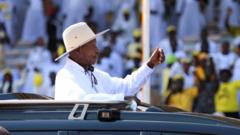
Yoweri Museveni, 81, won disputed elections in January to extend his 40-year rule.
Uganda's Yoweri Museveni sworn in for a seventh consecutive term after winning disputed elections
Copyright current_year BBC. All rights reserved. The BBC is not responsible for the content of external sites. Read about our approach to external linking.
Copyright current_year BBC. All rights reserved. The BBC is not responsible for the content of external sites.
Read about our approach to external linking.
Yoweri Museveni is the only president many Ugandans have lived under
Uganda's President Yoweri Museveni, in a white shirt and a white hat, salutes his supporters from an open-top black vehicle after his swearing-in ceremony - 12 May 2026
Uganda's president sworn in for record seventh term
Uganda's President Yoweri Museveni, 81, has been sworn in for a record seventh consecutive term following his landslide victory in disputed elections in January, extending his tenure as one of Africa's longest-serving rulers.
Heavy security, including armoured tanks, were deployed in the capital, Kampala, ahead of the inauguration in what police said were measures intended to maintain public order.
Museveni told the crowd that his new term should be regarded as a time for "no more sleep for all Ugandans".
He added that people should focus on creating more wealth and jobs - and build on the progress made over last 40 years through the achievement of peace and the development of infrastructure.
Museveni was declared the winner of the election with more than 70% of the vote, with his term expected to end in 2031.
His main rival, pop star turned politician Bobi Wine, rejected the result, saying the poll was marred by "ballot-stuffing". Election officials denied the allegation.
The 44-year-old opposition leader, whose real name is Robert Kyagulanyi Ssentamu, fled the country after the election, saying he feared that "the regime wanted to eliminate me".
Museveni first came to power as a rebel leader in 1986 but since then has won seven elections.
He is among the few African leaders in power for more than 40 years. Others include Congo-Brazzaville's Denis Sassou Nguesso, Equatorial Guinea's Teodoro Obiang and Cameroon's Paul Biya.
The government declared the day a public holiday and the president's supporters thronged to the Kololo Independence Grounds in Kampala for the swearing-in ceremony.
Gen Muhoozi Kainerugaba, Uganda's Chief of Defence Forces in military jungle uniform
This army chief threatened to castrate opposition leader and claimed descent from Jesus
Slashed incomes and gamers go cold turkey: the fallout from Uganda's internet shutdown
In his address, Museveni said that his government would would use revenue from planned oil production to grow the economy and alleviate poverty.
"We must protect what has been achieved, correct what still needs improvement and move forward together as one country," he added.
African leaders who attended the ceremony included Tanzania's President Samia Suluhu Hassan, the Democratic Republic of Congo's Félix Tshisekedi, South Sudan's Salva Kiir and Somalia's Hassan Sheikh Mohamud.
Uganda has one of the world's youngest populations, with majority of the people having known no other president.
Museveni has not indicated when he intends to retire, but analysts say this is likely to be his last term.
His 51-year-old son, Gen Muhoozi Kainerugaba, the military chief, has been widely tipped as a potential successor.
However, Kainerugaba has increasingly faced criticism for the way he uses social media to threaten the opposition, including Wine.
On X earlier this year, he threatened to have Wine's testicles removed in posts that have since been removed.
Wine, who leads the National Unity Platform party, said the results of the elections were "fake" and urged Ugandans to fight back for their democracy.
The government insisted that the elections were free and fair, and Museveni accused the opposition of seeking to overturn the results through violence, calling them "terrorists".
Wine went into hiding after raids on his house, and accused security forces of targeting him and his family.
Police denied the allegations, insisting they were only providing security for him as a presidential candidate.
Museveni's government has continued to face criticism from rights groups over a security force crackdown following the disputed vote.
Last month, Amnesty International said that at least 16 people had likely been killed between 15 and 18 January by the military and the police. It said the victims were reportedly unarmed and posed no imminent threat.
The rights group has also been critical of the treatment of another key opposition politician, Kizza Besigye, who remains in jail since late 2024 after being dramatically abducted while visiting Kenya and forcibly taken to Uganda.
He was later charged in a military court with possession of pistols and attempting to purchase weapons abroad - accusations which he denies.
Last week, the government passed a Sovereignty Bill that criminalises actions deemed to promote "the interests of a foreigner against those of Uganda" and labels recipients of foreign funding as "agents of foreigners".
Museveni speaks into a yellow microphone, wearing a similarly coloured yellow shirt
He once criticised African leaders who cling to power. Now he's won a seventh term
A close-up shot of Bobi Wine looking at the camera while sitting down. He is wearing a blue suit and has short hair and a beard.
Ugandan opposition leader tells BBC he fled abroad fearing for his life
A woman looking at her mobile phone and the graphic BBC News Africa
Go to BBCAfrica.com for more news from the African continent.
for more news from the African continent.
Follow us on Twitter @BBCAfrica, on Facebook at BBC Africa or on Instagram at bbcafrica
A fan club in the African state record themselves singing a Sky Blues club anthem.
Unwitting donors hand over money to save suffering animals but Ugandan con artists pocket the cash.
Christopher Okello Onyum had pleaded insanity but this was dismissed by the judge.
The home affairs minister hails the ruling as a "victory" against the "abuse" of the refugee system.
In a first since these meetings started in the 1970s, this move reflects a change in France's thinking.
A fishermen's leader tells the BBC that 40 people are feared dead - either in the strikes or drowning as they tried to flee.
The French president stood up during a conference in Kenya to tell the audience to quieten down, saying it was “impossible” for speakers to be heard.
Ships have rerouted around the Cape of Good Hope since 2023 to avoid conflicts in the Middle East.