
World
Giant new dinosaur identified from fossils in Thailand
May 14, 2026 International Source: BBC World
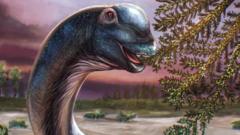
The nagatitan is the largest dinosaur found in South-East Asia and weighs as much as nine elephants.
Giant new dinosaur identified from remains found in Thailand
Copyright current_year BBC. All rights reserved. The BBC is not responsible for the content of external sites. Read about our approach to external linking.
Copyright current_year BBC. All rights reserved. The BBC is not responsible for the content of external sites.
Read about our approach to external linking.
Artist reconstruction of the Nagatitan, a dark blue long-necked dinosaur eating leaves from a tree.
Giant new dinosaur identified from fossils in Thailand
The nagatitan lived between 100 and 120 million years ago
A new type of giant long-necked dinosaur, twice the size of a tyrannosaurus rex, has been identified up by scientists from remains dug up in Thailand.
The nagatitan, the largest-ever dinosaur found in South-East Asia, weighed 27 tonnes - as much as nine adult Asian elephants - and measured 27m (88ft) in length, longer than a diplodocus. Like that dinosaur, it belonged to the sauropod family of long-necked herbivores.
A team of researchers from the UK and Thailand identified the species from fossils found beside a pond in north-eastern Thailand a decade ago.
They say the discovery sheds light on how changes in ancient climatic conditions allowed gigantic dinosaurs to develop.
The dinosaur's full name is Nagatitan chaiyaphumensis, with "naga" referring to a serpent in South-East Asian folklore, "titan" referring to the gods in Greek mythology, and chaiyaphumensis meaning "from Chaiyaphum", the province where the fossils were discovered.
, with "naga" referring to a serpent in South-East Asian folklore, "titan" referring to the gods in Greek mythology, and chaiyaphumensis meaning "from Chaiyaphum", the province where the fossils were discovered.
It lived between 100 and 120 million years ago - around 40 million years earlier than the tyrannosaurus rex - and is about twice the size of that creature.
Thitiwoot Sethapanichsakul, a Thai doctoral student at University College London (UCL), was the lead author of the study which was published in the Scientific Reports journal.
He said the researchers referred to the nagatitan as "the last titan" of Thailand, because the fossils were found in the country's youngest dinosaur-bearing rock formation.
"Younger rocks laid down towards the end of the time of the dinosaurs are unlikely to contain dinosaur remains because the region by then had become a shallow sea. So this may be the last or most recent large sauropod we will find in South-East Asia," he said.
Researcher Thitiwoot Sethapanichsakul posed with a front leg bone of the nagatitan
Researcher Thitiwoot Sethapanichsakul poses with a front leg bone which is taller than him.
Sethapanichsakul, a self-confessed "dinosaur kid", said in a UCL press release that the study also "fulfils a childhood promise of naming a dinosaur".
The nagatitan is the 14th dinosaur to be named in Thailand. Palaeontologist Dr Sita Manitkoon, from Mahasarakham University, said that the country has a high diversity in dinosaur fossils and is "possibly the third most abundant in Asia in terms of dinosaur remains".
The nagatitan roamed Earth when the planet's atmospheric carbon dioxide levels were rising in line with high global temperatures.
The study's co-author, UCL's Prof Paul Upchurch, said the sauropod family of dinosaurs had become quite large at this time, telling National Geographic: "It seems a little odd that sauropods were able to cope with higher temperature conditions", as large bodies retain heat and are harder to cool down.
He told the Reuters news agency that it was "likely that the high temperatures had an impact on the plant fodder that was important to sauropods, which were very large-bodied herbivores".
A complete fossil skeleton in the Dinosaur Isle visitor tourist attraction exhibition of an Iguanadon, a plant eating dinosaur with pointed thumbs.
Why are these beaches so rich in fossils?
A 3D digital rendering of a dinosaurs jawbone showing rows of curved and serrated teeth
New dinosaur species named after fossil analysis
The dinosaur has brown green skin against a black background. Its face is like a crocodile with prominent spikes coming out of its neck and the top of its head - with smaller spikes running down its back
'Punk rock' dinosaur with metre-long spikes discovered
The image shows an artist's impression of the newly discovered dinosaur. It walks on two hindlegs and has an elongated head with sharp teeth.
New species of dinosaur discovered that 'rewrites' T.rex family tree
Jo Ingram is on the mend after falling while pony trekking - deemed an "extreme sport".
Thaksin seems incapable of taking a back seat. This time, it really could be different.
For the last three decades, one man and his political dynasty have loomed large over Thailand's politics.
New and exciting fossils emerge into the light of day on the Isle of Wight and the Jurassic Coast.
As Sir David Attenborough turns 100 years old, here is how he helped nature in Hampshire and Dorset.
Giant octopuses may have ruled the oceans 100 million years ago, according to fossil evidence.
The Thalattosuchian's jawbone was a chance find on a guided fossil walk run by a museum.
Patagotitan mayorum is the largest known dinosaur ever to walk the Earth.