
World
BBC on the ground during march through Jerusalem's Old City
May 15, 2026 International Source: BBC World
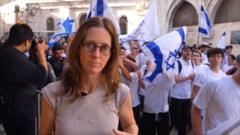
Tens of thousands of Israeli celebrants have marched through the area captured by Israel in the 1967 Arab-Israeli war.
Copyright current_year BBC. All rights reserved. The BBC is not responsible for the content of external sites. Read about our approach to external linking.
Copyright current_year BBC. All rights reserved. The BBC is not responsible for the content of external sites.
Read about our approach to external linking.
Lucy Williamson standing in front of a Jerusalem Day flag march in Israel
Watch: BBC on the ground during march through Jerusalem's Old City
BBC on the ground during march through Jerusalem's Old City
Tens of thousands of Israeli celebrants have marched through Jerusalem's Old City, captured by Israel in the 1967 Arab-Israeli war.
Israeli annexation of East Jerusalem is not recognised by many of its allies, including the UK.
The annual march is frequently accompanied by racist chants and violence towards Palestinian residents and businesses.
The BBC's Middle east correspondent Lucy Williamson spent the day on the ground observing the commemorations.
The BBC’s Nawal Al-Maghafi has been piecing together what happened on 8 April 2026, after one of the deadliest chapters in the country’s recent history.
Capt Raman Kapoor's ship is one of several to be stranded in the strait in the midst of the power struggle between the US and Iran.
Richard Manville has lived in the UK all his life, but now he's leaving for Israel because he says the antisemitism here is intolerable.
Before the fragile ceasefire in the region, this was one of the most heavily targeted US and UK military bases in the Middle East.
Israel and Hezbollah are still fighting in Lebanon despite a US-brokered ceasefire that began 12 days ago.
The US president says he saved eight Iranian women from execution, but Iran says otherwise.
The 300 couples were selected in a draw of nearly 2,000 people to be a part of the joint celebration.
The US and Iran's rival blockades of the Strait of Hormuz have become a "test of wills", says Lyse Doucet.
Analysis indicates that parts of the video appear to have been filmed hours after the ships were reportedly seized.
The BBC's Azadeh Moshiri is in Islamabad, where preparations for the peace talks continue, despite no confirmed date.
Esmail Baghaei expressed concern regarding the US’s naval blockade of its ports and the seizure of an Iranian vessel.
BBC Arabic's correspondent Carine Torbey reports from the border town of Khiam, as the ceasefire between Israel and Hezbollah in southern Lebanon goes into its second day.
Lyse Doucet says Iranians want a solution to the long-running animosity with the US, but leaders is not willing to make a deal on Washington's terms.
While military targets have been struck in Iran, civilian areas have too, showing the stark reality of the war.
The BBC's chief international correspondent Lyse Doucet arrived in Tehran to what she described as 'life on pause'.
BBC Security Correspondent Frank Gardner explains how the world's second-largest economy fits into the Gulf conflict.
BBC foreign correspondent Nick Beake visits Metula, an Israeli town surrounded on three sides by Lebanon.
BBC Middle East correspondent Hugo Bachega joins paramedics on duty in Nabatieh - a city that was once vibrant, but is now abandoned.
The BBC's security correspondent Frank Gardner explains how the US blockade of Iranian ports will work.
President Donald Trump launched the attack on Pope Leo after the pontiff criticised the war in Iran.
Iranian authorities have imposed an internet ban but using trusted sources, special correspondent Fergal Keane hears from those traumatised by conflict and government repression.
Thousands of people have taken part in the Palestine Marathon, which returns to Bethlehem after a two-year pause over the Gaza War.
President Trump has suspended anoperation to guide ships through the Strait of Hormuz - BBC Verify explains the timeline.
The United Arab Emirates (UAE) is quitting oil cartel Opec after nearly 60 years of membership.
Eyewitnesses captured the moment a burning fuel tanker drove through the centre of Hasakah, Syria, leaving a trail of fire behind it.
BBC Middle East Correspondent Hugo Bachega hears from people affected by this week's attacks.
Pro-government demonstrators poured onto the streets of the Iranian capital after the announcement of the two-week conditional ceasefire between the US and Iran.
The BBC's Nick Marsh takes a look at whether fuel costs will get cheaper now the US and Iran have agreed a ceasefire.
More than one million people in Lebanon have been displaced since the start of the war as Israel expands its ground operation there.
The BBC's Orla Guerin travels to the edge of the critical waterway that Iran has put a stranglehold on.
BBC reports from the funerals of three journalists killed by a targeted attack in southern Lebanon.
The BBC's Hugo Bachega speaks to families in Beirut as more than a million people have been displaced in Lebanon.
Paul Adams explains why it is so dangerous to navigate the strait, one of the world's busiest oil shipping channels.
Violence began after a teenage settler was killed, reportedly after being hit by a vehicle driven by a Palestinian.
Israeli forces have been instructed to destroy the crossings over the Litani river that were being used by Hezbollah to send reinforcements.
The BBC's Sebastian Usher reports from Dimona in southern Israel, which was hit by an Iranian missile.
In footage from Russian state broadcaster RT, correspondent Steve Sweeney is seen diving off screen as a missile hits.
At least 10 people were killed and 27 injured, according to Lebanon's state-run National News Agency.
Iranians speak about life during the war with constant threat of bombs and regime crackdowns.
Ben Chu from BBC Verify has been looking at what role the Royal Navy could play in the Strait of Hormuz.