
World
Trump says 20-year nuclear programme suspension by Iran would be enough
May 16, 2026 International Source: BBC World
The US president says Tehran has to show "real" commitment to removing nuclear fuel and stopping uranium enrichment.
Twenty years enough for Iran nuclear suspension, says Trump
BBC asks Trump if China will help open the Strait of Hormuz
Copyright current_year BBC. All rights reserved. The BBC is not responsible for the content of external sites. Read about our approach to external linking.
Copyright current_year BBC. All rights reserved. The BBC is not responsible for the content of external sites.
Read about our approach to external linking.
Trump was asked about Iran on his return flight from Beijing after meeting the Chinese president
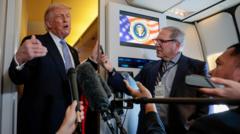
Donald Trump (L) stands on Air Force One speaking and gesturing to reporters holding microphones and phones
Trump says 20-year nuclear programme suspension by Iran would be enough
A split image shows a man in a blue suit standing in front of Air Force One on the left and President Trump is on the right.
US President Donald Trump has said he would accept a 20-year suspension by Iran of its nuclear programme, in what appears to be confirmation of a shift in position away from a demand for a total end to it.
Trump said it had to be a "real 20 years". Previously he has called on Iran to permanently cease enriching uranium - a stage in making a weapon - and to be prevented from ever acquiring nuclear weapons.
But he also said his patience with Iran was running out, with no sign of a breakthrough in talks.
Israeli and US forces began massive air strikes on Iran on 28 February. A ceasefire in place since last month meant to facilitate talks has been largely observed, despite some exchanges of fire.
Trump calls Iran response to US proposal to end war 'totally unacceptable'
Trump says Iran ceasefire is on 'massive life support'
Pakistan has been playing the role of mediator.
However, both sides appear to be far apart, having rejected each other's most recent proposals to end the war.
Iranian media said Tehran's proposal had included an immediate end to the war on all fronts - an apparent reference to Israeli attacks against its Shia ally Hezbollah in Lebanon - a halt to the US naval blockade of Iranian ports and guarantees of no further attacks on Iran.
Speaking to reporters on Air Force One after talks in Beijing with Chinese President Xi Jinping, Trump said the two sides had agreed Tehran could not be allowed to have a nuclear weapon and must reopen the Strait of Hormuz, which it is currently blocking, prompting a rise in world oil prices.
When a reporter suggested that a 20-year suspension of Iran's nuclear programme was not enough, he replied: "Twenty years is enough, but the level of guarantee from them, in other words it's got to be a real 20 years." He did no elaborate.
US media reported in April that during a session of talks in the Pakistani capital, Islamabad, Vice-President JD Vance had responded to an Iranian proposal to cease enrichment for five years by insisting on a minimum of 20 years.
However, this is thought to be the first time Trump himself has mentioned a 20-year timeframe.
In his first term as president, he withdrew from a 2015 nuclear agreement reached with Iran by the Obama administration. One of the reasons given was opposition to so-called "sunset clauses" that would have allowed some restrictions on Iran to expire over time.
Israel has so far not reacted to Trump's remarks. Prime Minister Benjamin Netanyahu has said that Iran's stockpile of enriched uranium must be "taken out" before the war against Iran can be considered over.
Netanyahu vehemently opposed the 2015 nuclear deal, partly on the grounds that the sunset clauses would leave open the possibility of Iran obtaining nuclear weapons and continuing to present a grave threat to Israel.
The US president criticises an Iranian counteroffer to end the war, and says the month-long ceasefire is "unbelievably weak".
President Trump has suspended anoperation to guide ships through the Strait of Hormuz - BBC Verify explains the timeline.
The US and Iran's determination to keep the pressure on each other has put the fragile Gulf ceasefire in serious jeopardy.
The US president says he wants Beijing and Taipei to "cool down" tensions over the self-governing island.
Charges could come as soon as next week in a case reportedly focused on Cuba's downing of two planes in 1996.
There were plenty of choreographed ceremonies but no trade breakthroughs after the two-day visit.
The BBC's Tom Bateman asked President Trump about China's willingness to pressure Iran to open the Strait of Hormuz.
President Trump has concluded a two-day visit to Beijing at a high-stakes summit with Chinese leader Xi Jinping.