
World
Inside the 'kill-zone' on Ukraine's front line, where new weapons have transformed war
May 18, 2026 International Source: BBC World
Machines are increasingly replacing humans on the front line, but troops are still vital for defending territory.
Inside the 'kill-zone' on Ukraine's front line, where new weapons have transformed war
Copyright current_year BBC. All rights reserved. The BBC is not responsible for the content of external sites. Read about our approach to external linking.
Copyright current_year BBC. All rights reserved. The BBC is not responsible for the content of external sites.
Read about our approach to external linking.
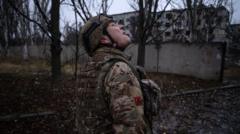
A member of the 93rd brigade checks the sky for drones in the frontline town of Kostyantynivka
A Ukrainian serviceman checks the sky for fpv-drones in the frontline town of Kostyantynivka, Donetsk region, amid the Russian invasion of Ukraine. taken in 2025
After 225 days stuck in a front-line foxhole, the Ukrainian infantryman's muscles were so weak he could barely walk.
His commanders had tried five times to swap him with another soldier - but they could never reach him. Rotating soldiers on the front line in eastern Ukraine is extremely difficult because of the constant threat of drones.
This area near Kostyantynivka is currently one of the most dangerous hotspots and the Ukrainian military admits that Russian forces have reached its outskirts.
Known as Kenya, the infantryman took two days to walk 11km (6.8 miles) to get back to his brigade, avoiding mines and hiding from drones to get out.
Map showing front line in eastern Ukraine
Ukraine's 93rd brigade has the job of defending Kostyantynivka and its surrounding towns and villages from Russia's advance.
If this highly strategic city falls, Moscow will be able to push towards the last remaining Ukrainian strongholds in the Donbas region – Kramatorsk and Sloviansk – from the north, east and south.
Vladimir Putin sees the capture of the Donbas as Russia's "priority goal", and Ukrainian intelligence says he wants it done this year. President Volodymyr Zelensky believes the Kremlin is planning another major offensive in the summer.
But Russia's campaign has lately become bogged down in the region.
Moscow gained half as much territory in the Donbas in April than in March, and a sixth of what it captured in December 2025, according to Ukrainian monitoring website DeepState.
Kenya's task was to maintain his position and listen for any movement outside. He and his comrade would engage only if Russian troops tried to move against them.
Watch: Kenya's story of 225 days inside Ukraine's 'kill zone'
"Most fighting was done by drones," he said. And these weapons have transformed how wars are fought.
Kenya and his brigade are living through what appears to be the paradox of modern warfare. As machines increasingly replace humans on the front line, the greater the role of troops becomes in either seizing land or defending it.
Gone are the battles where a column of tanks and waves of soldiers charge enemy positions.
Instead, assaults often involve two or three soldiers walking across a field or riding motorbikes, sometimes even on horseback or on bicycles.
Speed has become more important than armour if you want to survive inside the "kill-zone" - a wide and desolate area dominated by drones that hunt down anything that moves.
This is a grey zone along the front line within the range of drones piloted remotely from both sides.
"Every time when we had to come out of our positions, we prayed we would come back alive," said Kenya. "At night, we had to put on anti-drone cloaks to protect us against thermal cameras, but they would last for 20 minutes at the most."
Drones cannot seize positions; they cannot control heights and crossings.
So, even in the age of robots and remotely operated weapons, the old rule of war is still true: without boots on the ground, an army cannot hold territory.
That is why Ukraine keeps soldiers like Kenya in small foxholes and dugouts inside the kill-zone, where they can do little more than stay and mark that territory.
Their biggest fear is being detected by the Russians. That's what happened to Khani, who spent 122 days at the front. He came to Ukraine as a Palestinian student in the 1990s and stayed.
Khani's position was in the basement of a two-storey house, when it was turned into rubble by Russian drones and artillery.
When the Russians tried to enter the basement, he and his fellow soldiers opened fire, revealing their positions.
"Once they knew we were there, they first dropped explosives from drones, then kamikaze drones attacked us," he recalls.
A drone attached to fibre-optic cables managed to fly inside the basement, but it became tangled up in its wires at the entrance and started spinning, so Khani shot at the cable reel and the drone lost connection with the pilot operating it.
At this point two Russian soldiers stormed his position. "They detonated anti-tank mines outside and destroyed the entrance, burying it under debris. They thought we were dead."
They survived thanks to a hidden exit they had dug just in case.
Granata, who recently left the front after 110 days, says the soldier he was with was badly wounded when Russian forces dropped an explosive containing gas in an attempt to force them to abandon their positions.
All supply routes in the Donbas kill-zone are now cut off, so food and ammunition has to be delivered to forward posts by aerial drones. But even they are unreliable: they often get destroyed or jammed, so supply deliveries have been intermittent.
Kenya said his meagre food supplies would often end up being eaten by mice. "They gnaw everything except metal. Because of the mice, we had to eat all food products except canned food quickly, or else the mice would destroy them all."
When asked what they lacked most in their foxholes, the soldiers all said it was water.
"The most memorable moment for me was when it rained," said Kenya. "I got undressed and went outside to wash myself."
During the winter, temperatures dropped to -25C, so old, worn-out sleepings bags were of little use when they slept on the frozen ground or a cold concrete floor.
Khani's partner fell ill and "one day he just didn't wake up," he said. He died of hypothermia.
Ukraine's military says Russian forces are regrouping along the front line, ahead of a possible summer offensive.
To counter that, the Ukrainians say they have increased attacks on Russian military logistics and supply routes.
This too may have slowed down the Russian advance. According to the US-based Institute for the Study of War, last month Moscow lost more territory in Ukraine than it managed to gain.
But it is still the foot-soldiers at the front of the kill-zone who still have the biggest task to hold on to Ukrainian territory. Without them, says Khani, the front line would collapse.
Stylised image showing a map of Ukraine overlaid with images of tanks and a soldier holding a shoulder launcher
Ukraine in maps: Tracking the war with Russia
Russian National Guard officers walk across Red Square decorated for the Victory Day military parade in Moscow, Russia, on May 6, 2026.
Rosenberg: Russia's Victory Day parade with no tanks a sign Ukraine war not going to plan
People in Oleshky gather for food delivery
To stay or risk the 'Road of Death' - Ukrainian civilians trapped in frontline city
Ukraine's president says the strikes are a "justified" response to deadly Russian attacks on Ukrainian cities.
Foreign visitors to Goa have nearly halved from their pre-Covid peak even as domestic tourism is booming.
Among the victims in Kyiv was 12-year-old Lyubava Yakovleva, whose father was killed during the war.
It is being used as a fertiliser as costs rise due to the war in the Middle East.
BBC Verify has examined dozens of videos of fibre-optic drone attacks carried out by the Lebanese armed group.
Philip Wilkinson says police should spend more on technology such as drones rather than aircraft.
Reform says it is "proud" of the move, but the Conservatives have branded it "performative".
A police force says the initiative is already saving lives and money.